How to Assign Jobs to the Closest Qualified Technician, and What Extra Driving Costs
Check skills, then availability, then distance. What each extra mile and minute costs a five-technician team, and the four assignment rules compared.
Assign each job in this order: first filter to the technicians qualified to do it, then to those free in the customer's window, then pick the one with the shortest drive, and use current workload to break a tie. Distance comes third because sending the wrong person costs a second visit, but it is the step most dispatchers skip when the board is busy, and it adds up. The IRS standard business rate rose to 76 cents a mile from July 1, 2026 (IRS, Announcement 2026-11), and the median HVAC technician earns $29.33 an hour (U.S. Bureau of Labor Statistics, 2025). At those rates, five extra miles and ten extra minutes on every job cost a five-technician team about $3,649 a month.
What does extra driving cost a service business?
More than the fuel. A mile of avoidable driving costs the vehicle, and a minute of it costs a paid technician who isn't working.
- Vehicle cost. The IRS business rate was 72.5 cents a mile for the first half of 2026 and 76 cents from July 1 (IRS, Announcement 2026-11), a common stand-in for what a mile of vehicle use costs a business. In Canada, the tax-exempt allowance for 2026 is 73 cents a kilometre for the first 5,000 km and 67 cents after that, with territories four cents higher (Department of Finance Canada, 2026).
- Paid time. HVAC, refrigeration and heating mechanics and installers earned a median $29.33 an hour, or $61,010 a year, in May 2025 (BLS, 2025). That is wages only, before payroll taxes, benefits and the vehicle the technician is sitting in.
- The slot. Ten minutes lost driving on each of four jobs is 40 minutes a day, which on many days is the difference between fitting in a fifth call and sending it to tomorrow. We can't put a sourced number on that one, so the example below leaves it out.
A worked example
These are assumptions, not industry averages. Change them to your own numbers.
| Input | Value | Where it comes from |
|---|---|---|
| Technicians | 5 | Assumption |
| Jobs per technician per day | 4 | Assumption |
| Working days per month | 21 | Assumption |
| Extra distance per job, compared with the closest qualified technician | 5 miles (8 km) | Assumption |
| Extra drive time per job | 10 minutes | Assumption (about 30 mph) |
| Vehicle cost per mile | $0.76 | IRS standard business rate from July 1, 2026 |
| Wage per hour | $29.33 | BLS median for HVAC mechanics and installers, May 2025 |
That team runs 420 jobs a month. Five extra miles each is 2,100 miles, or $1,596.00 at the IRS rate. Ten extra minutes each is 70 technician-hours, or $2,053.10 in wages. Together: $3,649.10 a month, $8.69 a job, about $43,800 a year. In Canada, the same 8 km a job is 3,360 km a month, or C$2,452.80 in vehicle cost alone at 73 cents a kilometre, falling to 67 cents once a driver passes 5,000 km in the year.
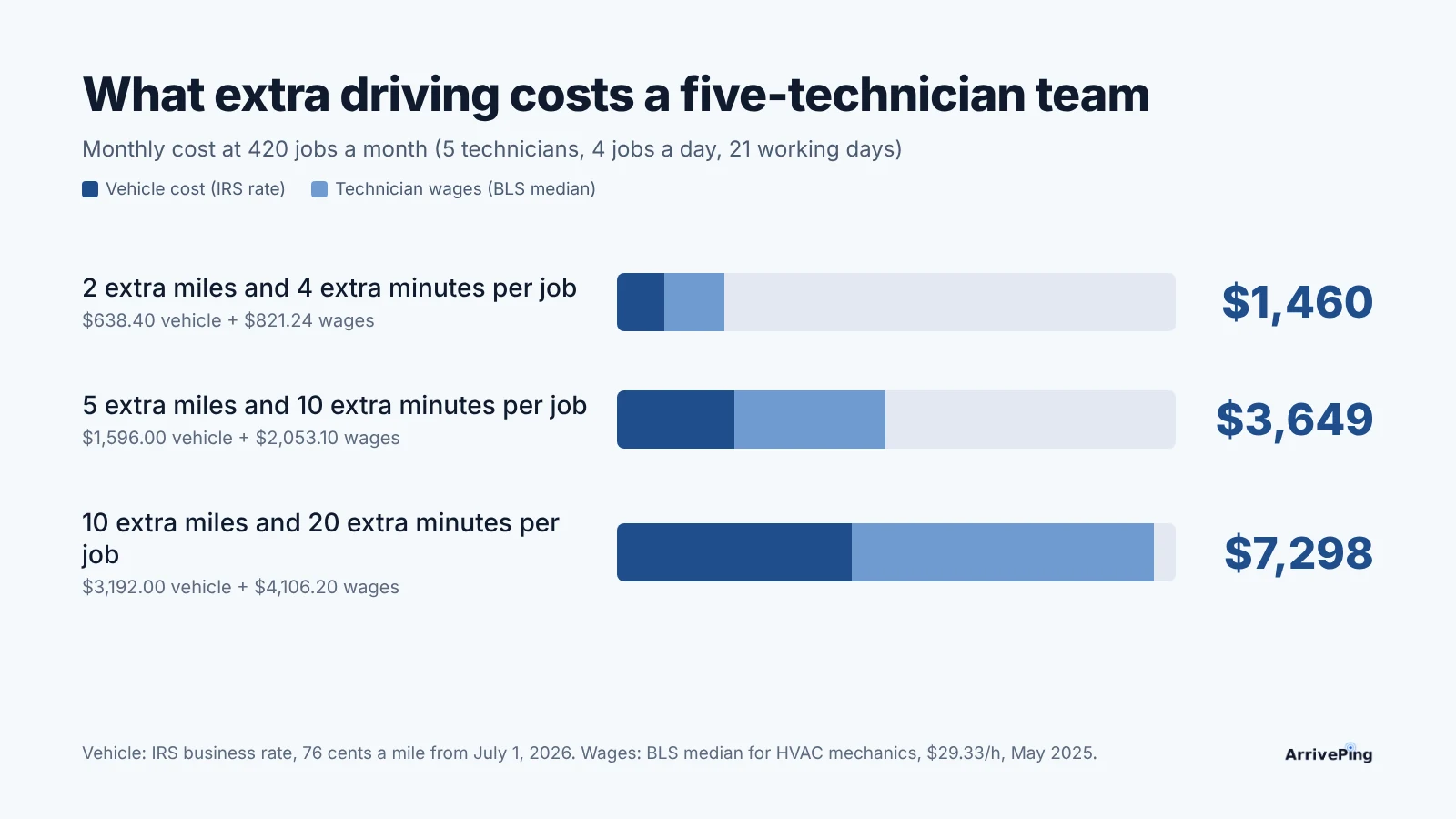
The point isn't the exact figure. It is that the cost scales with every job, every day, so a dispatch habit that adds a few miles per call is one of the larger line items a small service business never sees on an invoice.
Why isn't the closest technician always the right one?
Because the closest person who can't do the job costs a second trip, and some jobs legally require a certification. The BLS notes that the U.S. Environmental Protection Agency "requires nearly all HVAC technicians to be certified in proper refrigerant handling" (BLS, 2025). Under Section 608 of the Clean Air Act, anyone who maintains, services, repairs or disposes of equipment that could release refrigerants must be certified, at a level that matches the equipment: Type I for small appliances, Type II for high-pressure systems, Type III for low-pressure systems, or Universal for all three (EPA).
So the order matters:
- Qualified. Does this person hold the licence, ticket or certification the job needs, and have they done this kind of work? A gas fitter, a backflow tester and a Type II refrigerant certification are filters, not preferences.
- Available. Are they free in the customer's window, not on recorded time off, and not already booked at that time?
- Closest. Of the people left, who has the shortest drive from where they are now, or from their previous job if the next one is later?
- Least loaded. If two are about equal, give it to the one with fewer open jobs.
Skipping step one to save miles is the expensive mistake. Skipping step three every time is the slow, invisible one.
Which assignment rule should you use?
There are four common ways to hand out unassigned work automatically. Each is right for a different kind of business, and many teams use one rule for urgent jobs and another for routine ones.
| Rule | Who gets the job | Good for | Watch for |
|---|---|---|---|
| Nearest available | The closest technician who is free, with fewest open jobs as the tie-break | Same-day and emergency calls; dense service areas | Set a distance cap and require a skill match, or the nearest unqualified person wins |
| Round-robin | The next person in turn, among the team or a group | Sharing work fairly when pay depends on jobs; teams with similar skills | Ignores distance, so a turn can send someone across town |
| Zone owner | The technician who owns the area the job is in | Maintenance routes, repeat customers, large territories | A busy zone overloads one person; decide what happens to a job outside every zone |
| Load balance | Whoever has the fewest open stops, then whoever is free soonest, then distance | Long or uneven jobs; keeping everyone busy | Can trade extra miles for an even board |
If you aren't sure, start with nearest available, capped at a distance you would actually drive, with a skill match required. It is the rule that makes the cost in the worked example go away, and the guardrails keep it from sending the wrong person.
How do you dispatch the closest technician when nobody is at the desk?
Many small teams don't have a full-time dispatcher. The owner is on a roof, the office manager is answering the phone, and jobs sit unassigned until someone has a minute. Automatic assignment fixes that, but only if you trust it, and trust is earned in steps:
- Run the rule in suggest mode first. Let it name the technician it would pick and have a person confirm. After a week you'll know whether you agree with it.
- Switch on automatic assignment for one kind of job. Urgent calls are a good start, because speed matters most and the rule is simplest. Keep routine work manual until the first part is boring.
- Keep the guardrails on whatever does the assigning. No double-booking, no assigning over time off, and a clear record of which jobs a rule assigned so anyone can override it.
- Decide what happens when a technician declines. Sending the job back to a visible queue is safer than silently offering it to the next person, because someone notices.
The same order (qualified, available, closest, least loaded) is what a good dispatcher does in their head. Writing it down as a rule is how it survives a busy Monday.
How do you know if your assignments are working?
Measure the drive, not the feeling. Record the miles and the drive time on every job for two weeks before you change anything and two weeks after. Then look at three things:
- Average miles and minutes per job. This is the number the worked example is built on.
- Jobs that went to someone who wasn't the closest qualified technician. Some will have a good reason (a customer who asked for Jordan, a part that was in one van). The ones without a reason are your habit.
- Second visits caused by the wrong skill. If these go up when miles go down, your skill filter is too loose.
For how the location data gets collected without a tracker in every vehicle, see phone vs. vehicle GPS tracking. If you are deciding how much of dispatch to automate at all, AI-powered dispatch software covers the wider picture.
Playbook: tighten your assignments this week
- Write down your skill filters. List every licence, ticket and certification a job can require, and record which technicians hold each. Put the requirement on the job type, not in someone's memory.
- Pull last week's jobs. For each one, note who went and who was the closest qualified technician at the time. Count the mismatches.
- Put a number on it. Multiply your average extra miles by 76 cents (or 73 cents a kilometre in Canada) and your extra minutes by your technicians' hourly cost. Use your own wage, not the BLS median.
- Pick one rule. Nearest available with a distance cap and a skill match is the usual start. Run it in suggest mode for a week.
- Turn on automatic assignment for urgent jobs only, once you agree with the suggestions most of the time.
- Re-measure after two weeks and compare miles, drive time and second visits per job.
How ArrivePing does this
ArrivePing is field service software made by NVC360 in Winnipeg, Manitoba. It began as the dispatch tool for National Interiors, a specialty subcontractor that ran more than 800 field technicians, which is where the "closest qualified person" rule comes from.
- Ranking on four signals. ArrivePing's dispatch software ranks technicians by distance to the job, matching skills, availability and current workload, and assigns the best fit or suggests it to a dispatcher. Each technician has a skill class and skill tags (EPA 608, gas fitter, backflow tester), and the job carries the ones it needs.
- The four rules above, built in: nearest available tech (with a distance cap, 60 km to start, and an optional skill-class match), round-robin, zone owner and load balance. Each rule starts by suggesting; automatic assignment is a separate switch, and jobs a rule assigned carry a purple A badge.
- Guardrails either way. Double-booking and time-off checks run whether a person or a rule does the assigning. A declined job goes straight back to the dispatch queue rather than to the next technician, so someone sees it.
- Distance from the phone, not a tracker. Location comes from the ArrivePing app on the phone each technician already carries (technician GPS tracking), and the route, mileage and travel time for each job are recorded on the job report, so you can run the before-and-after check above on your own numbers.
- Every plan includes automatic assignment, from $49 USD a month for one dispatcher and two drivers, with a 30-day free trial (pricing).
When ArrivePing isn't the right choice: if your day is a long list of stops to put in order, such as parcel or courier routes with dozens of drops per driver, you need multi-stop route optimization. ArrivePing assigns the closest qualified person to each job and shows the drive to that stop; it doesn't sequence a full day of deliveries.
FAQ
How do I assign jobs to the closest technician?
Filter first to the technicians qualified and free for the job, then pick the one with the shortest drive from where they are now, and use the number of open jobs to break a tie. Dispatch software that knows each technician's live location and skills can do this automatically, or suggest the pick for a person to confirm.
How much does extra driving cost a field service business?
Vehicle cost plus paid time. At the IRS rate of 76 cents a mile and the BLS median HVAC wage of $29.33 an hour, five extra miles and ten extra minutes per job cost about $8.69 a job, or $3,649 a month for five technicians doing four jobs a day over 21 working days.
Should the closest technician always get the job?
No. Qualification and availability come first: a technician without the right certification, such as an EPA Section 608 certification for refrigerant work, causes a second visit that costs more than the miles saved. Distance decides between the people who can do the job in the customer's window.
What is the difference between round-robin and nearest-available dispatch?
Nearest available gives the job to the closest free technician and minimizes driving. Round-robin hands out jobs in turn to share work evenly, regardless of distance. Many teams use nearest available for urgent calls and round-robin or zone ownership for routine work.
What is the CRA mileage rate for 2026?
The 2026 tax-exempt automobile allowance in the provinces is 73 cents a kilometre for the first 5,000 km and 67 cents for each kilometre after that. In the territories it is 77 cents and 71 cents.
Sources
- Internal Revenue Service, Announcement 2026-11 (standard mileage rates for July 1 to December 31, 2026), Internal Revenue Bulletin 2026-29. https://www.irs.gov/irb/2026-29_irb
- U.S. Bureau of Labor Statistics, Occupational Outlook Handbook: Heating, Air Conditioning, and Refrigeration Mechanics and Installers (pay data for May 2025). https://www.bls.gov/ooh/installation-maintenance-and-repair/heating-air-conditioning-and-refrigeration-mechanics-and-installers.htm
- Department of Finance Canada, Government Announces the 2026 Automobile Deduction Limits and Expense Benefit Rates for Businesses, January 2026. https://www.canada.ca/en/department-finance/news/2026/01/government-announces-the-2026-automobile-deduction-limits-and-expense-benefit-rates-for-businesses.html
- U.S. Environmental Protection Agency, Section 608 Technician Certification Requirements. https://epa.gov/section608/section-608-technician-certification-requirements