No-Heat Calls in a Cold Snap: How to Triage Emergency Service Requests
In a cold snap every caller says it's an emergency. The safety questions to ask first, a four-tier triage table, and who to send to a no-heat call.

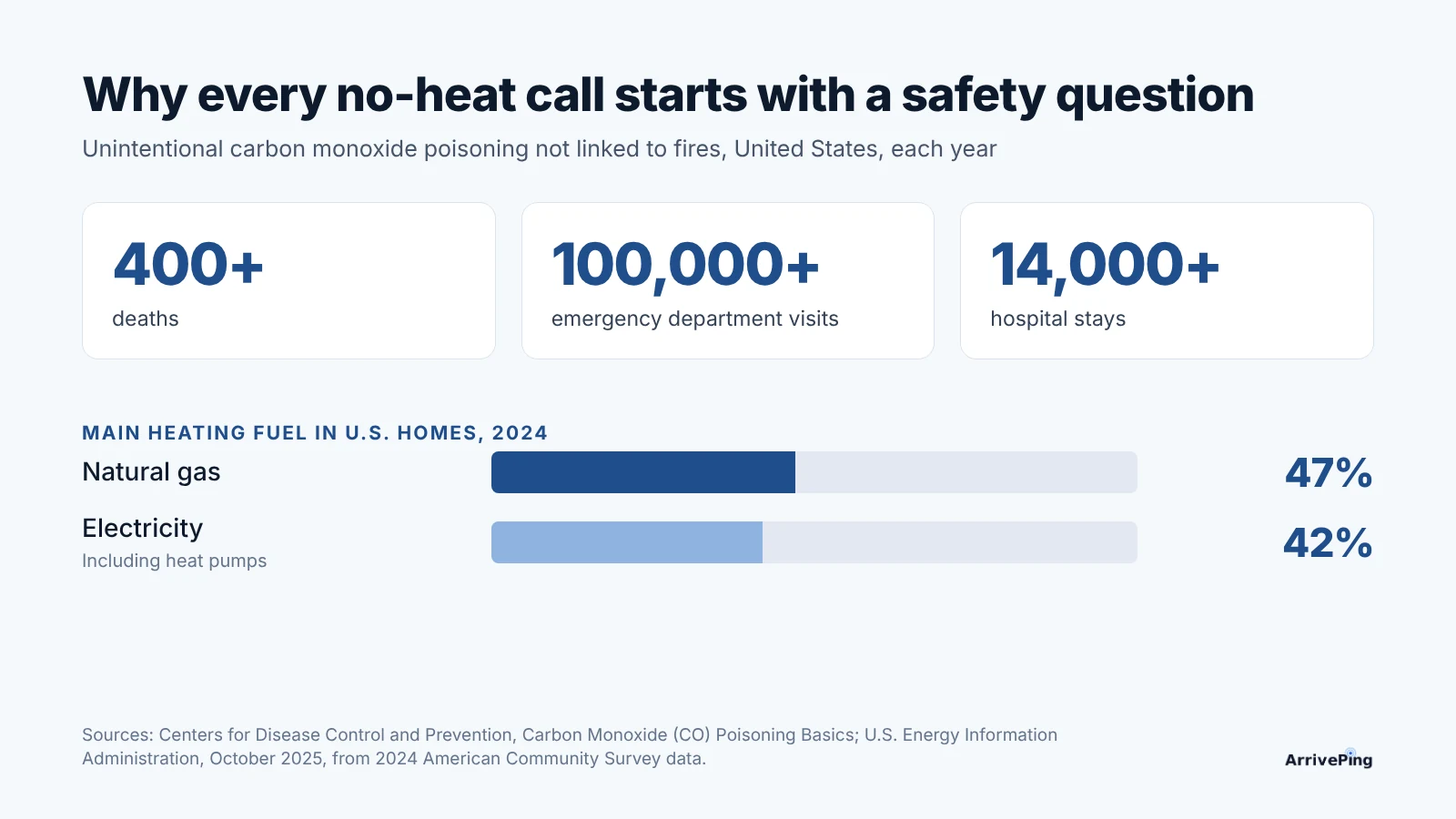
Triage a no-heat call in three passes: safety first, then who is in the home and how fast it's getting cold, then who can get there soonest with the right licence. The safety pass comes first because most no-heat calls are about equipment that burns fuel: natural gas is the main heating fuel in 47% of U.S. homes (U.S. Energy Information Administration, 2025), and unintentional carbon monoxide poisoning not linked to fires kills more than 400 Americans a year (Centers for Disease Control and Prevention). A caller with a sounding CO alarm needs to leave the house, not wait for a booking.
Why does a no-heat call start with a safety question?
Because a furnace that has stopped working can also be a furnace that is venting badly, and the caller can't tell the difference.
- How common the risk is. Each year, unintentional carbon monoxide (CO) poisoning not linked to fires kills more than 400 Americans, sends more than 100,000 to an emergency department and puts more than 14,000 in hospital (CDC).
- Where it comes from. The CDC's list of CO sources includes "fireplaces, gas ranges, or furnaces", along with small engines, stoves, lanterns and grills (CDC).
- What it feels like. The CDC lists the most common symptoms as "headache, dizziness, weakness, upset stomach, vomiting, chest pain, and confusion" (CDC). A caller who mentions a headache and a dead furnace in the same breath is not a routine booking.
- How many homes burn fuel for heat. Natural gas is the main heating fuel in 47% of U.S. homes and electricity in 42%, from 2024 Census data; propane, heating oil and wood are more common in the coldest areas (EIA, 2025).
So the first two questions on any no-heat call are the same every time: Do you smell gas? Is a carbon monoxide alarm going off, or does anyone feel sick? A yes to either is an emergency, not a booking. Tell them to get everyone out and call 911 or their gas utility's emergency line from outside, then book the visit once the utility or fire department has been.
How cold is too cold to wait?
Colder than people expect. Canada's government warns that "you can still get a cold-related injury at moderately cold or near-freezing (0°C) temperatures", and that "even normal winter temperatures in Canada can be harmful, especially for those at-risk" (Government of Canada). A house with no heat doesn't reach freezing in an hour, but in a cold snap it falls steadily, and some people in it can't wait as long as others.
That is why the second pass is about the people and the house, not the equipment:
- Who is home? A baby, an older person, someone unwell or with limited mobility moves the call up.
- How cold is it inside now, and how fast is it dropping? Ask for the thermostat reading, and ask again if you call back.
- Is there any other heat? A working fireplace, a safe electric space heater or a second zone buys time.
- Is anything at risk of freezing? Plumbing on outside walls, a vacant rental, a crawl space.
Which no-heat calls go first?
Use a fixed set of tiers, so every dispatcher sorts the same way and every caller gets an honest answer.
| Tier | Situation | What the dispatcher does | When someone goes |
|---|---|---|---|
| Emergency | Gas smell, CO alarm sounding, or CO symptoms | Tell them to leave and call 911 or the gas utility from outside; book after | Once the scene is declared safe |
| Urgent | No heat, and a vulnerable person in the home or pipes at risk of freezing | Mark it urgent; send the qualified technician who can get there soonest, even if another job moves | Same day, as soon as possible |
| High | No heat, healthy adults, some backup heat | Book today or the first slot tomorrow morning; call back if it changes | Today or first thing tomorrow |
| Normal | Partial heat: one cold room, noisy furnace, short cycling | Next open slot; suggest they call back if it stops working | Next available |
Write the tiers down and keep them by the phone. In a cold snap, every caller describes their call as an emergency, and the dispatcher who answered thirty of them by noon needs a rule, not a judgement call.
Who should you send?
The person who can get there soonest and fix it. Closest-first is the wrong rule for an urgent call if the closest technician is in the middle of a two-hour install or doesn't hold the right ticket.
- Gas equipment needs someone licensed to work on it in your state or province.
- Heat pumps are a growing share: EIA says air-source heat pumps have driven the growth of electric heating, especially in colder climates (EIA, 2025). In the U.S., work on the refrigerant circuit needs a technician certified for refrigerant handling under Section 608 of the Clean Air Act (EPA).
- Availability beats distance for urgent work. A technician finishing up 15 minutes away often beats one who is free but 40 minutes away. The general order (qualified, available, closest, least loaded) is in our post on assigning the closest qualified technician.
When an urgent call bumps someone else's routine visit, move that visit and tell that customer straight away; the steps are the same as on a morning when a technician calls in sick.
What should the caller do while they wait?
Give every caller the same short, safe advice, and write it into your script: keep doors to unused rooms closed, gather people in one room, use only heaters designed for indoor use, and never heat the house with a gas oven, a grill or a generator, all of which the CDC lists as CO sources (CDC). Tell them roughly when the technician will arrive, and that they'll get a message when the technician is on the way.
Playbook: before the first cold snap
- Write the two safety questions at the top of the call script and train everyone who answers the phone, including whoever covers evenings.
- Print the four-tier table and put it next to the phone and in the after-hours script.
- Record who holds which licence and certification, so an urgent job can go straight to someone who can fix it.
- Leave one slot per technician open on cold-snap days for urgent calls, and fill it with routine work only after noon.
- Make urgent calls visible the moment they're booked, so they don't sit in a queue behind routine ones.
- Prepare the "your visit is moving" message for routine customers bumped by an emergency.
- After the cold snap, review: time from call to arrival for each tier, and how many routine visits moved.
How ArrivePing does this
ArrivePing is field service software made by NVC360 in Winnipeg, Manitoba. It began as the dispatch tool for National Interiors, a specialty subcontractor that ran more than 800 field technicians.
- Priority on every job. Low, Normal, High or Urgent, set when the job is booked or later. For High and Urgent jobs, ArrivePing's dispatch software ranks the technician who can go now above the one who is merely closest, using each technician's open jobs and when they're projected to be free.
- Only qualified technicians first. Each technician has a skill class (HVAC, Plumbing and others) and skill tags you write, such as gas fitter or EPA 608. Set them as required on the job and the ranking puts qualified people first. In the Scheduler, Find a slot shows the best three fits, ranked by skill, drive time and how full each day is.
- Urgent calls get noticed. The "Urgent job → alert the office" automation notifies the office the moment an Urgent job is created, including one from your online intake form. An assignment rule can be limited to Urgent jobs, so emergencies are suggested or assigned on their own while routine work waits for a dispatcher.
- Bumped customers are told. Moving a routine job in the Scheduler sends that customer an updated confirmation. All of this is part of ArrivePing's field service management software, from $49 USD a month for one dispatcher and two technicians, with a 30-day free trial (pricing).
When ArrivePing isn't the right choice: ArrivePing doesn't answer the phone. If after-hours calls go to an answering service, that service's script does the safety questions and the first sort; ArrivePing takes over once the job is booked or comes in through your intake form.
FAQ
How do you triage a no-heat call?
Ask the safety questions first: does anyone smell gas, is a carbon monoxide alarm sounding, does anyone feel sick? A yes is an emergency: everyone out, call 911 or the gas utility. Otherwise, rank the call by who is in the home, how cold it is getting and whether there is backup heat, then send the qualified technician who can get there soonest.
Is no heat an emergency?
It depends on who is in the home and how cold it is. No heat with an infant, an older person or someone unwell in the house, or pipes at risk of freezing, should be treated as urgent and handled the same day. No heat for healthy adults with backup heat can usually wait for the first slot the next morning.
What questions should a dispatcher ask on a no-heat call?
Do you smell gas? Is a CO alarm going off or does anyone have a headache, dizziness or nausea? Who is in the home? What does the thermostat read now? Is there any other heat source? Is anything at risk of freezing? What kind of system is it: gas furnace, boiler, heat pump or electric?
What should I do while I wait for a furnace repair?
Close doors to rooms you aren't using, gather in one room, and use only heaters made for indoor use. Never heat the house with a gas oven, a grill or a generator, which can produce carbon monoxide. If a CO alarm sounds or anyone feels sick, get out and call 911.
Should an emergency call go to the closest technician?
Not automatically. It should go to the technician who holds the right licence or certification and can arrive soonest. Someone finishing a job nearby often beats someone who is free but farther away.
Sources
- Centers for Disease Control and Prevention, Carbon Monoxide (CO) Poisoning Basics. https://www.cdc.gov/carbon-monoxide/about/index.html
- U.S. Energy Information Administration, Electricity use is becoming more common for residential heating, Today in Energy, October 10, 2025. https://www.eia.gov/TodayinEnergy/detail.php?id=66324
- Government of Canada, Extreme cold and cold warnings. https://www.canada.ca/en/services/environment/weather/severeweather/extreme-cold-warning.html
- U.S. Environmental Protection Agency, Section 608 Technician Certification Requirements. https://epa.gov/section608/section-608-technician-certification-requirements