Swing for Base Hits: Why Small Businesses Should Buy Software That Pays Off on Day One
Big software rollouts run over budget and under-deliver. Why small service businesses win with low-cost, low-training tools that pay back in weeks, not years.

Most small and mid-sized service businesses get more from software that is cheap, quick to learn and live in a day than from a platform that promises to run everything. The evidence on big rollouts is blunt: in McKinsey and the University of Oxford's study of more than 5,400 IT projects, large projects ran "45 percent over budget" and delivered "56 percent less value than predicted" (McKinsey, 2012). In baseball terms, the home-run swing misses far more often than it connects. The base hit is how small teams win.
This post covers what the research says about big versus small software projects, what small-business buyers actually expect, and a short test for telling a base-hit tool from a home-run pitch.
Why do big software rollouts so often disappoint?
Enterprise systems look impressive in a demo because they can do almost everything. The cost shows up after the contract: integration partners, data migration, configuration, and training for people in dispatch, accounting, sales and the field. The bigger the scope, the more of those pieces have to go right at once.
- They run over budget and under-deliver. McKinsey's research with Oxford, covering projects with initial budgets above $15 million, found large IT projects ran 45% over budget and 7% over time on average, and delivered 56% less value than predicted. It also found that "17 percent of IT projects go so bad that they can threaten the very existence of the company" (McKinsey, 2012).
- ERP is the classic example. Gartner predicts that "by 2027, more than 70% of recently implemented ERP initiatives will fail to fully meet their original business goals" (Gartner).
- Transformations rarely land as planned. Bain & Company's 2024 survey of more than 400 executives found that 88% of business transformations fail to achieve their original ambitions (Bain & Company, 2024).
- Most of what you pay for goes unused. Pendo's analysis of product usage found that "80 percent of features in the average software product are rarely or never used" (Pendo, 2019). Zylo's 2025 index puts the average organisation's waste on unused SaaS licences at $21 million a year (Zylo, 2025).
These numbers come mostly from large companies. That's the point: they are the businesses with IT departments, project managers and consulting budgets, and they still struggle. A 6-truck operation where the owner also dispatches has none of that cushion.
Do smaller software projects really succeed more often?
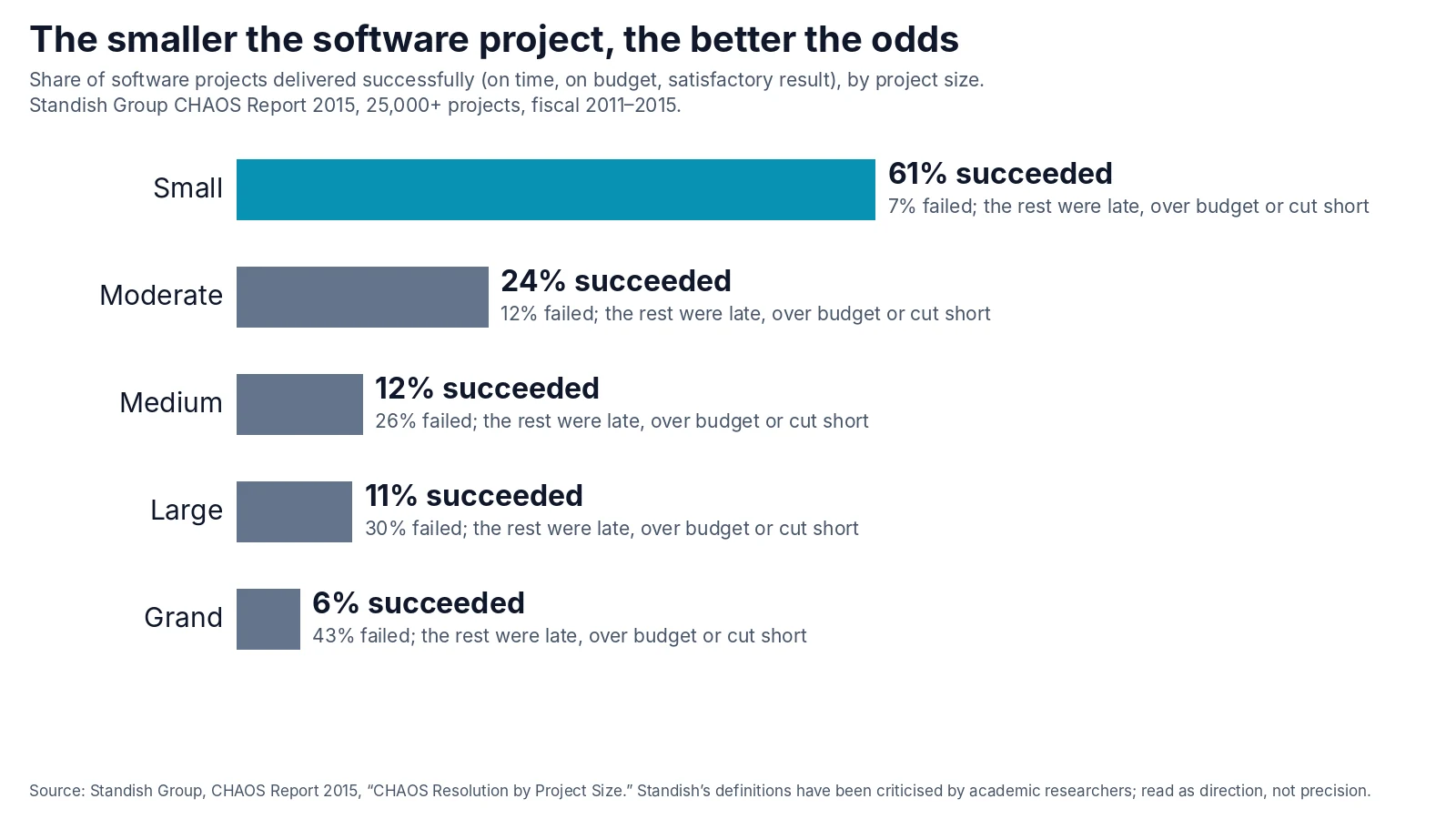
Yes, by a wide margin. The Standish Group's CHAOS Report 2015 sorted more than 25,000 software projects from fiscal 2011 to 2015 by size. Small projects succeeded 61% of the time and failed outright 7% of the time. "Grand" projects succeeded 6% of the time and failed 43% of the time (Standish Group, 2015).
| Project size | Succeeded | Challenged (late, over budget or cut short) | Failed |
|---|---|---|---|
| Small | 61% | 32% | 7% |
| Moderate | 24% | 64% | 12% |
| Medium | 12% | 62% | 26% |
| Large | 11% | 59% | 30% |
| Grand | 6% | 51% | 43% |
Source: Standish Group, CHAOS Report 2015, "CHAOS Resolution by Project Size."
A caveat worth stating: Standish's definitions and data have been criticised by academic researchers, notably Eveleens and Verhoef in IEEE Software (2010). Treat the exact percentages as direction, not precision. The direction, though, matches McKinsey's and Gartner's findings: the more a project tries to change at once, the worse its odds.
What does the baseball analogy actually look like in numbers?
In the 2025 Major League Baseball season, hitters came to the plate 182,926 times. They hit 26,115 singles and 5,650 home runs (Baseball-Reference, 2025). That works out to a single in about 14% of plate appearances and a home run in about 3%, and singles made up roughly 65% of all hits.
Home runs win highlight reels. Singles fill the bases. A software decision works the same way: a modest tool that works on Monday and saves the office an hour a day is a base hit. Stack a few of them and the score moves. The all-in-one platform is the home-run swing: when it connects, it's big, but most swings don't, and a miss costs a year and a budget.
What do small-business software buyers actually expect?
Fast payback and fewer surprises. The buyer research lines up.
- Return within months. In G2's 2024 survey of 1,940 B2B decision makers, "57% of buyers expect to see positive ROI within 3 months of purchase," and 78% expect it within six months of implementing (G2, 2024).
- Regret is common. In Gartner Digital Markets' 2025 survey of 3,500 software buyers, 59% regretted at least one software purchase from the past 18 months, and 49% of those cited higher costs as a result (Gartner Digital Markets, 2025). Capterra's analysis of the same research found small and mid-sized businesses most often blame a vendor missing deadlines (31%) and most often feel they wasted money (Capterra, 2025).
- Buyers decide by trying it. The same Gartner research found that 62% of buyers call the product trial their top factor in the final decision (Gartner Digital Markets, 2025).
- Small businesses hesitate for good reason. In Xero's 2021 survey of 4,211 small businesses across six countries, nearly one in three said they continually delay investing in new technology, and more than six in ten Canadian respondents felt overwhelmed by the options (Xero, 2021).
Put together: small businesses want a quick win they can prove in a trial, and they've often been burned by projects that promised more than they delivered.
How do you tell a base hit from a home-run pitch?
Use this table when a vendor is pitching you. The left column is what tends to pay back in weeks; the right is what tends to need a project plan.
| Question | Base-hit software | Home-run platform |
|---|---|---|
| What does it cost to start? | A published monthly price, no setup fee | A quote after a demo, plus implementation fees |
| Who sets it up? | You, in an afternoon | An implementation partner over weeks or months |
| How much training? | Your team learns it on the first job | Courses and sessions for several departments |
| What does it replace? | Nothing; it works alongside what you have | Several of your current systems at once |
| What hardware is needed? | The phones your team already carries | Often vehicle trackers, tablets or terminals |
| When do customers notice? | The first day | After go-live, if go-live happens on schedule |
| How do you get out? | Cancel the monthly plan; export your data | Multi-year contract and a migration project |
None of this makes large platforms bad. A 200-technician contractor with a full back office may need one. The mistake is buying the home-run swing when a base hit would solve this year's problem.
Playbook: how to buy software that pays off in the first week
- Name one problem, with a number. "Customers call the office about 15 times a day asking when we'll arrive" is buyable. "We need to modernise" isn't.
- Set a 30-day payback test. Decide before the trial what has to change in a month: fewer calls, fewer no-access visits, less time rescheduling. If the tool can't move it in 30 days, it's not a base hit.
- Keep what works. Don't let a new tool force you to replace accounting, CRM or invoicing that already works. Ask how it connects (export, Zapier, webhooks) instead.
- Count the hidden costs. Ask in writing about setup fees, implementation partners, training days, hardware and contract length. Add them to the monthly price before you compare.
- Trial with real work. Run a full day of real jobs, not a sandbox demo. If your field team needs a training session before they can use it, note that.
- Measure, then add the next base hit. After 30 days, keep it if the number moved. Then pick the next problem.
How ArrivePing does this
ArrivePing is field service software made by NVC360 in Winnipeg, Manitoba. It began as a tool built for National Interiors, a specialty subcontractor running more than 800 field technicians, and it's built to be a base hit for any business that sends people to customers: HVAC, plumbing and electrical teams, but also cleaners, installers, delivery crews and home-care providers.
- Live on the first day. You give the ArrivePing setup agent your website, and it builds your workspace with your brand, services, job templates and customer messages. Most teams dispatch their first job within an hour (field service software).
- Customers notice right away. When a technician starts driving, the customer gets a text with a live tracking page showing who's coming and the ETA, with your logo on every text, email and tracking page, in every plan (customer notifications).
- No hardware. Location comes from the technician app on the phone your team already carries, so there are no trackers to buy or install (fleet tracking).
- No replacement project. ArrivePing runs scheduling, assignment, tracking and customer updates alongside your accounting and CRM, and exports your data as CSV, Excel, PDF or JSON, or connects through webhooks, Zapier, Make or an MCP server for AI agents.
- No long commitment. $49 a month covers one dispatcher and two technicians, billed monthly with no large upfront cost, and every signup starts with a 30-day free trial (pricing).
When ArrivePing isn't the right fit: if you want one system for quoting, pricebooks, marketing campaigns, accounting and payroll, an all-in-one platform covers more of that, at a higher price and with a longer setup. If you already run a large contractor with a full back office and an implementation budget, an enterprise platform may be worth the swing. For a side-by-side, see ArrivePing vs. ServiceTitan and our buyer's guide for 3–10 tech shops.
FAQ
Why do enterprise software implementations fail so often?
Large projects change many things at once: several departments, data migration, integration with existing systems and training for many people. McKinsey and Oxford found large IT projects ran 45% over budget and delivered 56% less value than predicted, and Gartner predicts more than 70% of recent ERP initiatives will fail to fully meet their original business goals by 2027. The more that must go right together, the worse the odds.
How quickly should small business software pay for itself?
Most buyers expect it within months. In G2's 2024 survey, 57% of B2B buyers expected positive ROI within three months and 78% within six. For a small service business, a good test is whether the tool measurably changes one number, such as calls to the office or rescheduled visits, within a 30-day trial.
Is it better to buy an all-in-one platform or several simple tools?
It depends on size and back-office capacity. The Standish Group's CHAOS data shows small software projects succeeding far more often than large ones (61% versus 6% for the largest), so many small businesses do better adding one focused tool at a time that works alongside their existing systems. Large contractors with a full office may justify an all-in-one platform.
What hidden costs should I ask about before buying field service software?
Ask about setup or onboarding fees, whether an implementation partner is required, how many training days are included, any hardware such as vehicle GPS trackers, and the contract length and cancellation terms. Add these to the monthly subscription before comparing products, and confirm you can export your data if you leave.
How long does it take to set up ArrivePing?
Most teams dispatch their first job within an hour. The ArrivePing setup agent builds your workspace from your website, technicians use an app on the phones they already carry, and customers start receiving on-my-way texts with a live tracking link from the first job.
Sources
- Bloch, M., Blumberg, S. and Laartz, J. "Delivering large-scale IT projects on time, on budget, and on value." McKinsey & Company, October 2012. https://www.mckinsey.com/capabilities/tech-and-ai/our-insights/delivering-large-scale-it-projects-on-time-on-budget-and-on-value
- Gartner. "What IT Leaders Must Do to Avoid Disappointing ERP Initiatives." Checked October 27, 2026. https://www.gartner.com/en/information-technology/insights/what-it-leaders-must-do-to-avoid-disappointing-erp-initiatives
- Bain & Company. "88% of Business Transformations Fail to Achieve Their Original Ambitions; Those That Succeed Avoid Overloading Top Talent." April 15, 2024. https://www.bain.com/about/media-center/press-releases/2024/88-of-business-transformations-fail-to-achieve-their-original-ambitions-those-that-succeed-avoid-overloading-top-talent/
- Pendo. "The 2019 Feature Adoption Report." 2019. https://www.pendo.io/resources/the-2019-feature-adoption-report/
- Zylo. "2025 SaaS Management Index." January 16, 2025. https://zylo.com/news/2025-saas-management-index
- The Standish Group. "CHAOS Report 2015" (CHAOS Resolution by Project Size, FY2011–2015). 2015. https://wiki.sj.ifsc.edu.br/images/3/3b/CHAOSReport2015_rev.pdf
- Eveleens, J. L. and Verhoef, C. "The Rise and Fall of the Chaos Report Figures." IEEE Software, 2010. https://ieeexplore.ieee.org/document/5232804
- Baseball-Reference. "2025 Major League Baseball Standard Batting" (league totals). Checked October 27, 2026. https://www.baseball-reference.com/leagues/majors/2025-standard-batting.shtml
- G2. "2024 Buyer Behavior Report" (survey of 1,940 B2B decision makers, March 2024). https://learn.g2.com/hubfs/2024-buyer-behavior-report.pdf
- Gartner Digital Markets. "2025 Software Buying Trends Report" (survey of 3,500 software buyers). 2025. https://www.gartner.com/en/digital-markets/insights/2025-software-buying-trends
- Capterra. "Capterra's 2025 Tech Trends Report: SMBs vs. Enterprises." January 24, 2025. https://www.capterra.com/resources/tech-trends-smb-enterprise-software-purchase-tips/
- Xero. "Behavioural research by Xero uncovers barriers to small business technology adoption" (4,211 small businesses, six countries, July 2021). November 17, 2021. https://www.xero.com/ca/media-releases/ca-one-step/