No Call, No Show: What a Missed Service Appointment Really Costs
A missed or silent appointment costs the customer a day and costs you the customer. The data on waiting, no-shows and reviews, plus a five-moment fix.
A no-call, no-show is the most expensive event in a service company's week. The customer gave up a workday to be home: in the most-cited study of service waiting, half of Americans burned a sick day or vacation day to wait for an appointment, and more than a quarter lost wages (TOA Technologies / IBOPE Zogby, 2011). When nobody comes and nobody calls, that customer does not reschedule. They write the review, call a competitor, and take their next ten jobs with them.
The missed visit is rarely the root problem. The silence around it is. This post lays out what the data says a missed or late appointment costs, why customers describe the silence as worse than the delay, and the five moments at which a short message turns a bad day into a kept promise.
What customers are actually saying
Read a month of one-star reviews for home-service companies and the same sentence repeats. These are from public review pages and support forums posted between September 2025 and August 2026:
- "No technician showed up for the service appointment scheduled for today between 8am-5pm. No call and no text update was received." (appliance and HVAC repair reviews, September 2025)
- "He texts 4 times saying he was on his way." The technician never arrived (same source, September 2025).
- "Never showed up for my appointment nor did they ever text or call about missing the appointment." (HVAC contractor reviews, October 2025)
- "Appointment confirmation was between 3 and 4 pm and the truck pulls up at 1:30." (same source, May 2026)
- "They called me 40 min before the scheduled visit to tell me the tech couldn't make it," then a second cancellation at 3:20 pm inside a 4 to 7 pm window (in-home tech support reviews, August 2026).
- A 12 to 4 window stretched to 6 pm on three separate visits; the technician never came, and the phone agents could only repeat that he was "still coming" (satellite installation support forum).
Three patterns run through them. The window was too wide to plan a day around. The company knew the visit was slipping before the customer did and said nothing. And when the customer called, the office had no better information than the customer had.
The customer's bill for your missed visit
Waiting for a service appointment has been measured, and the numbers have not improved much since.
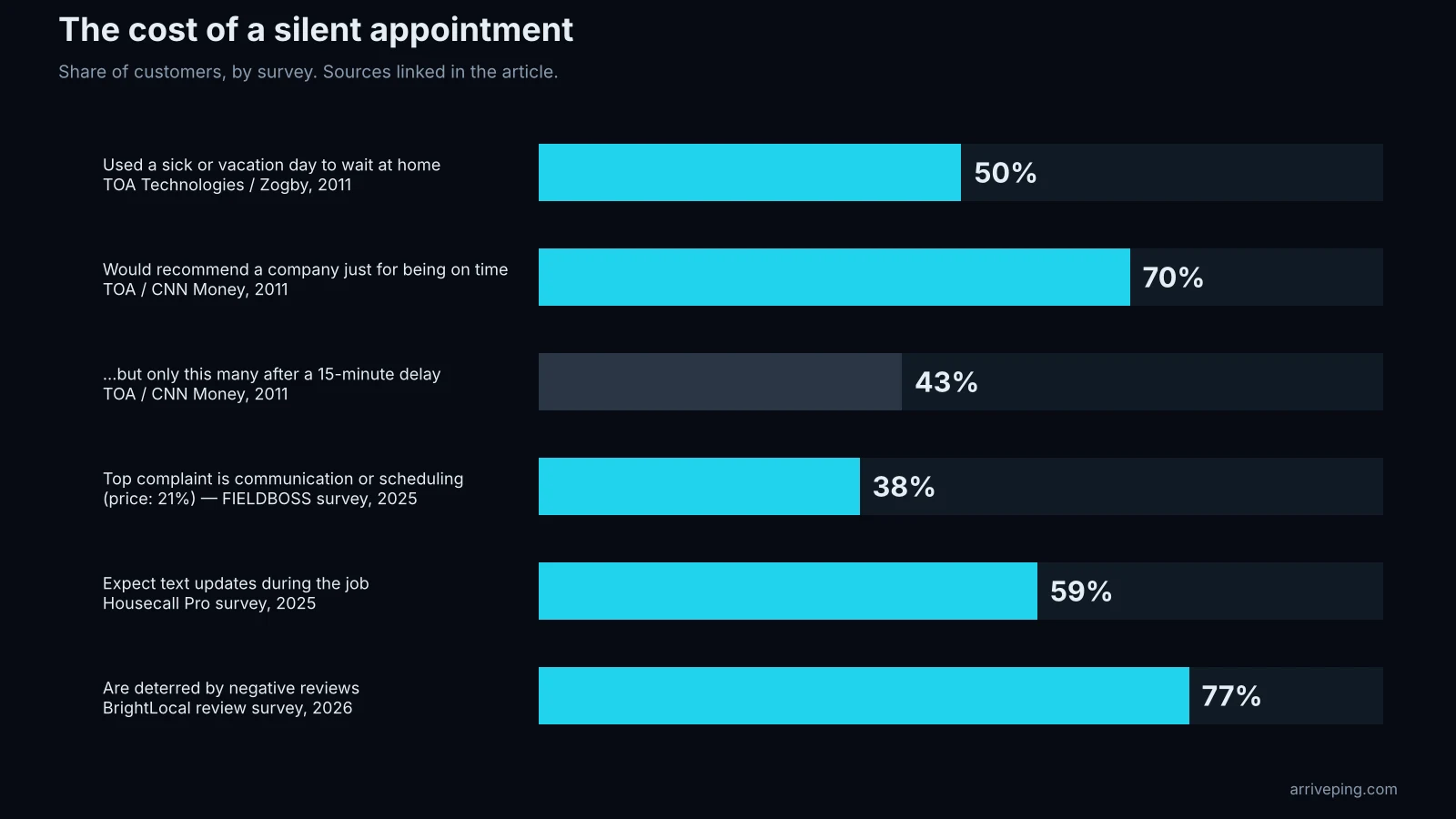
- Four and a half hours, and half a day off. In the TOA Technologies survey of 1,026 U.S. adults who had waited for a service or delivery appointment, the average wait was nearly four and a half hours, about two and a half hours longer than expected. 50% used a sick day or vacation day to wait at home, more than a quarter lost wages, and the study put the national cost of waiting at $37.7 billion for the year, close to $250 per person (TOA Technologies / IBOPE Zogby, 2011; CNN Money, 2011). The study is older than we would like, and it was commissioned by a scheduling-software vendor; it remains the only large survey that priced the customer's time, and the complaints above suggest the experience has not changed.
- Punctuality is a referral engine; lateness switches it off. In the same survey, 70% said they would recommend a company simply because the technician was on time. If they had to wait an extra 15 minutes, only 43% would (CNN Money, 2011).
- Communication beats price as the top complaint. FIELDBOSS surveyed 1,000 U.S. homeowners who had hired an HVAC professional in the previous year. About 38% named a communication or scheduling problem as their top complaint, against 21% who named price. The specific problems were technicians arriving "late or outside the scheduled time window" and "no updates on arrival times, delays, etc." The same homeowners expect fast service: 74% expect a visit within 24 hours when heating or cooling is out (FIELDBOSS, 2025). FIELDBOSS sells HVAC software, so read the headline as directional; the ranking matches what the reviews say.
- Late arrivals are a top-three frustration on their own. Housecall Pro's October 2025 survey of 1,040 U.S. homeowners found 35% frustrated by late arrivals, 59% expecting text updates during the job, and 58% wanting the technician's name and photo before the visit (Housecall Pro, 2025).
- Most days do not go to plan anyway. Salesforce's research with field technicians found 47% of appointments do not go as planned (Salesforce, 2025). A slipping schedule is normal. Letting the customer find out by waiting is the choice.
Your bill: the customer, the review and the next ten jobs
The customer's lost day becomes your lost revenue in three steps, each of which has been measured.
- The customer leaves. PwC's survey of 15,000 consumers found 32% would stop doing business with a brand they loved after one bad experience (PwC, 2018). Zendesk's 2025 benchmark puts it at more than half after a single bad experience and 73% after several (Zendesk, 2025). In home services, a no-show is the definition of a bad experience: the customer paid in time before you did any work.
- The review follows, and it works. BrightLocal's 2026 survey of 1,002 U.S. consumers found 97% read reviews for local businesses and 77% say negative reviews make them less likely to choose one. The same survey found 80% are likely to use a business that responds to all of its reviews, and 89% expect owners to respond (BrightLocal, 2026). One "they never showed up" review is read by every prospect who searches your name for the next two years.
- You pay to replace them. Harvard Business Review's summary of the retention literature puts the cost of acquiring a new customer at five to twenty-five times the cost of keeping one (HBR, 2014). Housecall Pro's homeowners said 68% would hire the same company again and 73% would refer it after an excellent experience (Housecall Pro, 2025). The missed visit forfeits the rehire, the referral and the acquisition cost at once. We worked through that arithmetic in Become the Preferred Provider.
Why the silence hurts more than the delay
Customers do not expect perfection. They expect to be told.
- They want the update, and they want it by text. 59% of homeowners expect text updates during the job (Housecall Pro, 2025). In J.D. Power's 2025 study of 10,348 vehicle owners, 56% of tire and quick-lube customers preferred text updates, and those who got the updates they preferred rated their experience 34 points higher on a 1,000-point scale (J.D. Power, 2025). Texts get read: 74% of consumers check a text notification within five minutes (SimpleTexting, 2026). The FIELDBOSS homeowners still split 50% phone to 24% text for how they want to hear from an HVAC company, so the right design is a text first and a call for anything that needs a decision (FIELDBOSS, 2025).
- Proactive beats reactive by a wide margin, and almost nobody does it. Gartner's survey of more than 6,000 customers found proactive service raised Net Promoter, satisfaction, effort and value scores by about a point each, yet only 13% of customers had received any proactive contact (Gartner, 2020). A "running 40 minutes behind" text sent before the window opens is proactive service. The same news delivered after the customer calls is a complaint.
- The office cannot say what it cannot see. The forum thread above is the usual failure: phone agents repeating "still coming" because the scheduling screen says so and nobody can see the truck. If dispatch does not know where the technician is, every slipping job becomes a customer phone call answered with a guess. We covered the dispatcher's side of this in End the 4-hour service window.
The five moments a customer must hear from you
A no-call, no-show is not one failure. It is five missed messages. Fix the messages and the no-show either does not happen or stops costing you the customer.
- Booked. Confirm the date, the window and who to contact, by text, within minutes. Include a cancellation path so the customer tells you when their day changes, instead of the reverse.
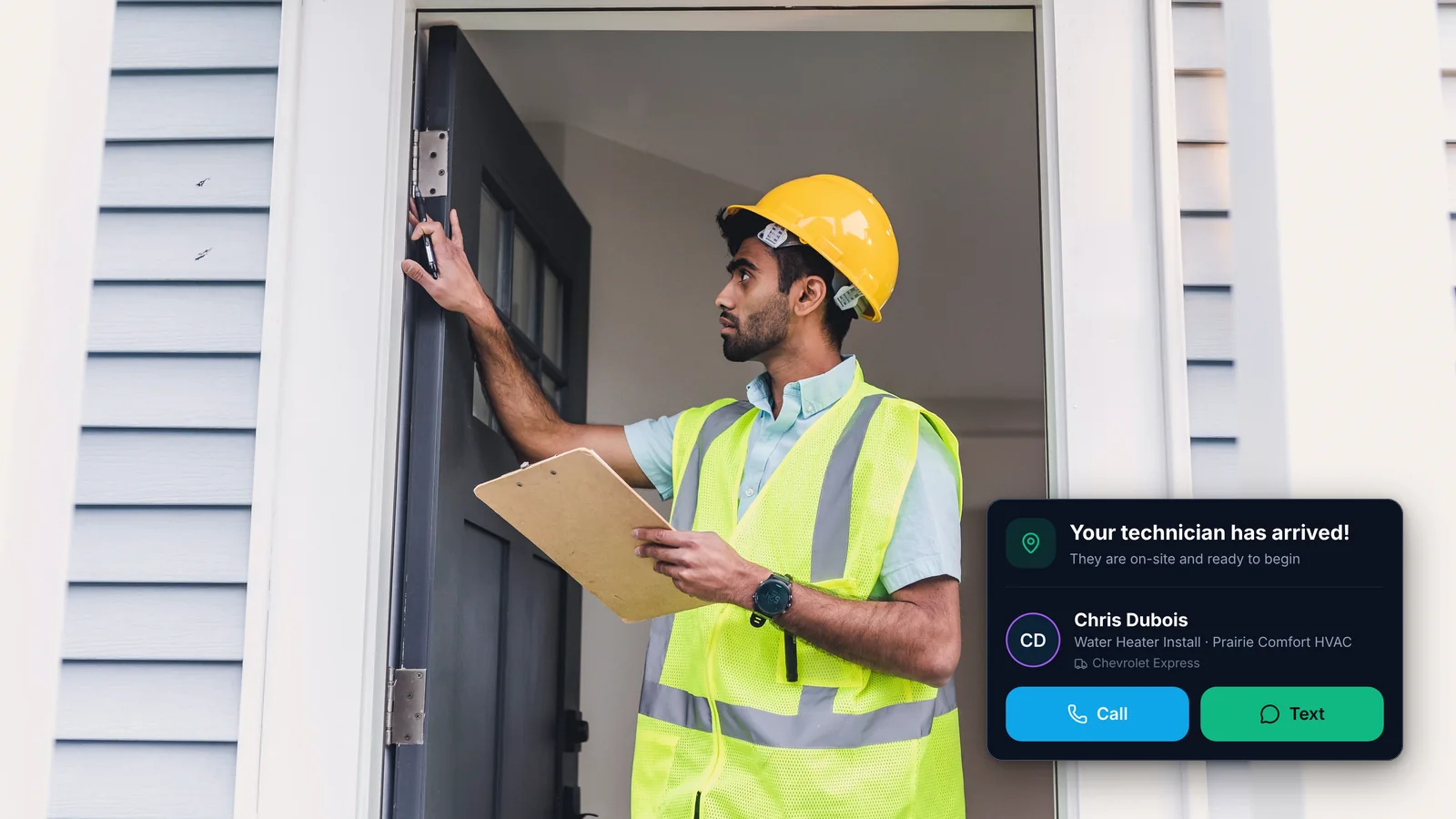
- The evening before. Re-confirm, and shrink the window. If your dispatch board shows the technician's first three jobs, you can usually promise a two-hour slot the night before. Add the technician's name and photo; 58% of homeowners want it (Housecall Pro, 2025).
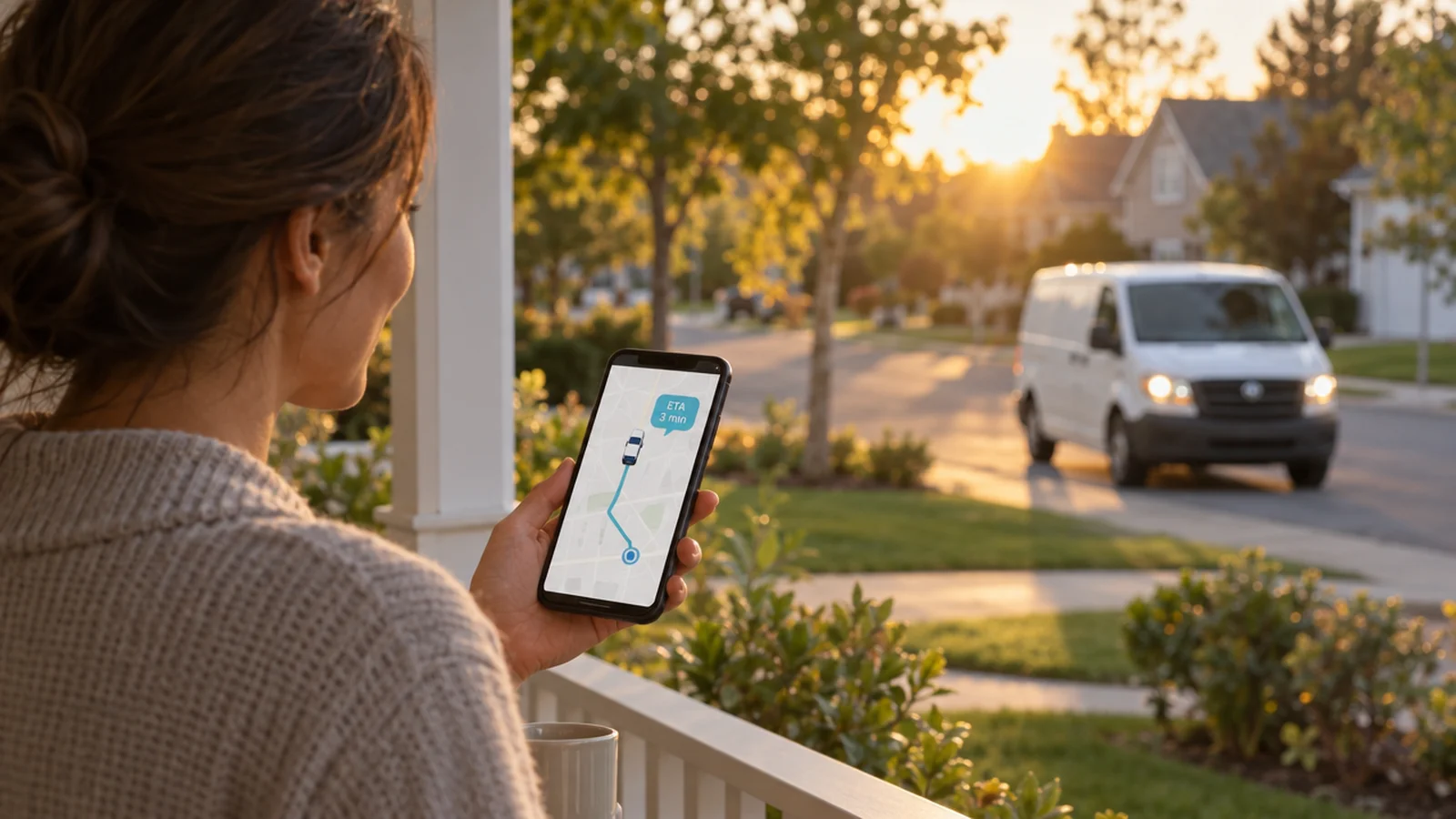
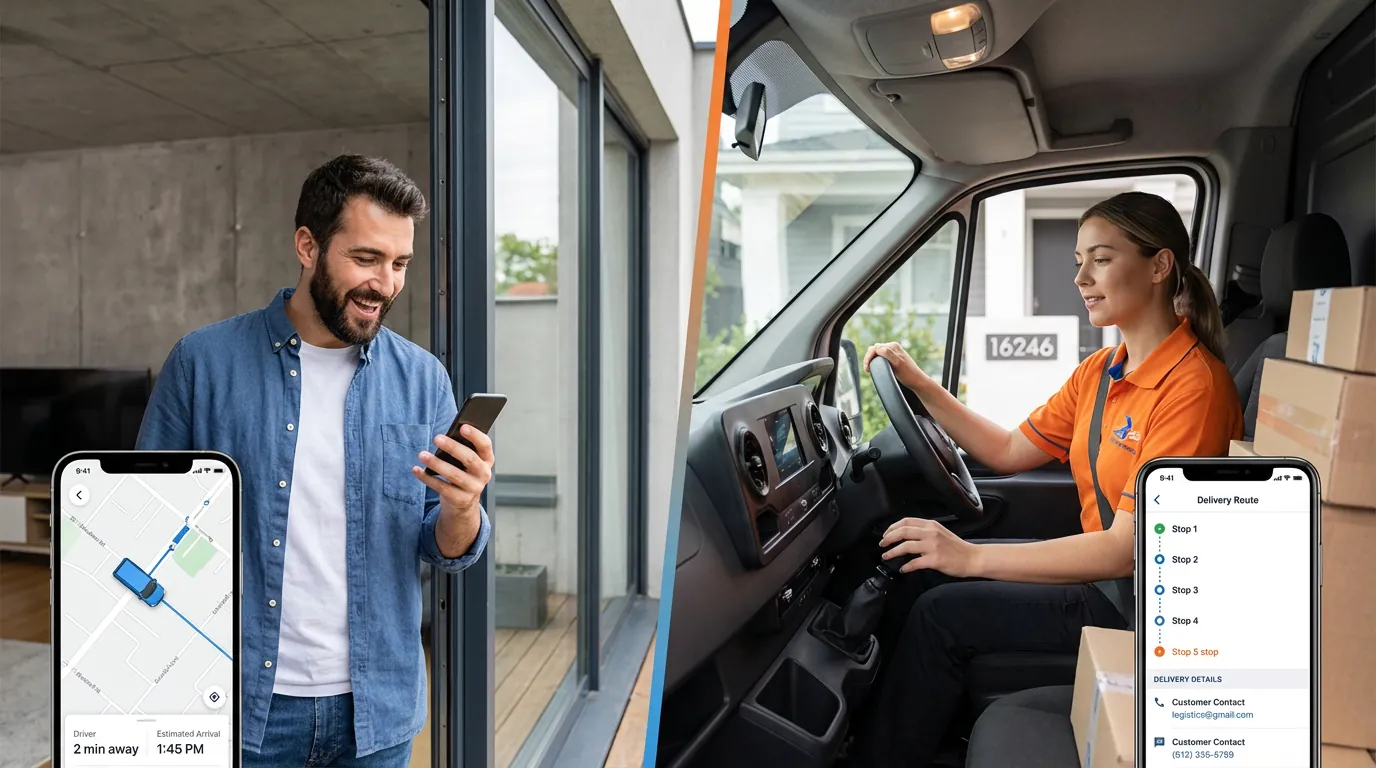
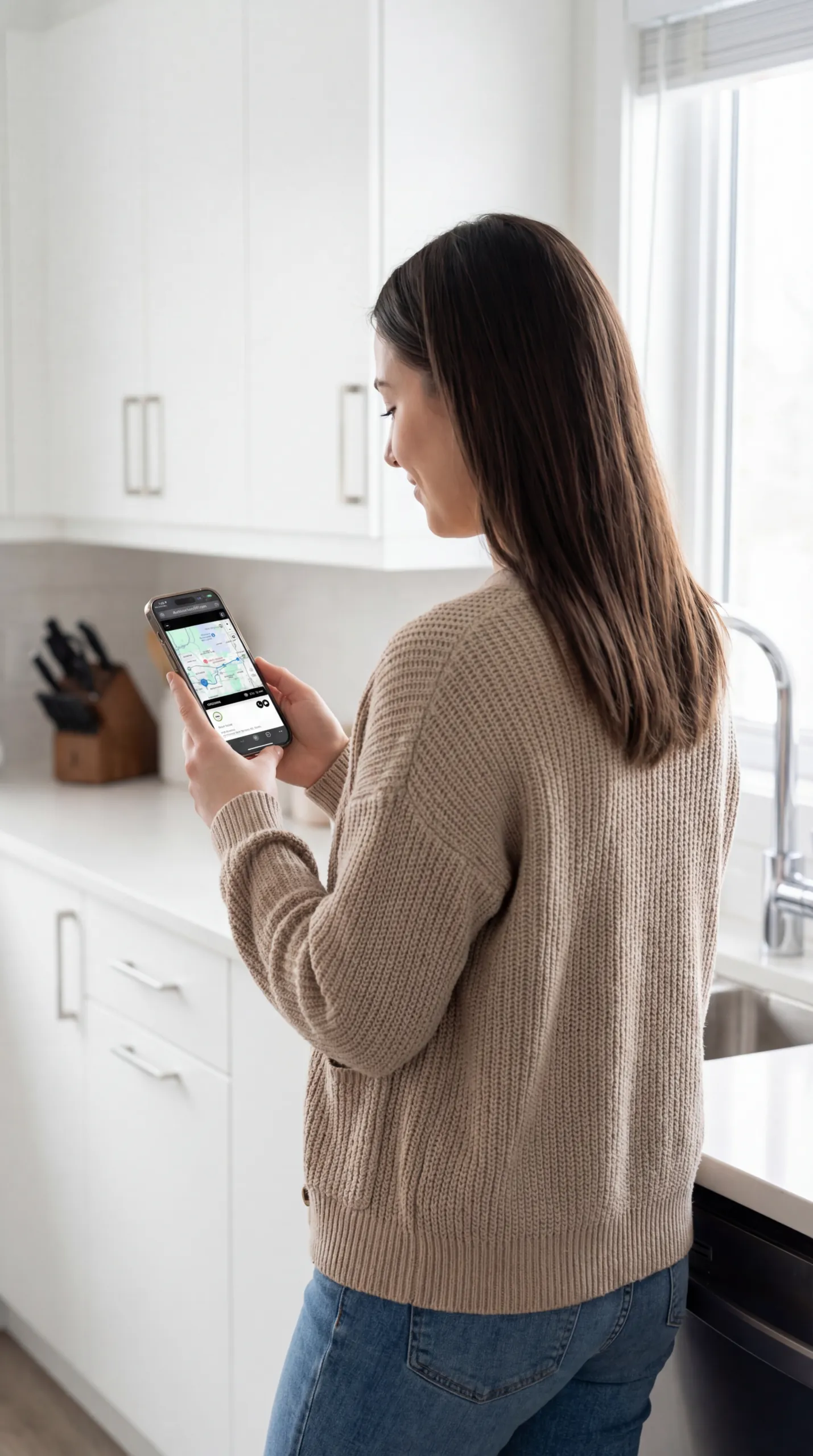
- On the way. Send a text with a live map and an ETA when the technician leaves the previous job. This is the one message that removes the "where are you" call entirely, because the customer can answer it themselves.
- Running late. The moment the ETA passes the window, the customer gets a new time, automatically, before they notice. Fifteen minutes is the threshold where recommendation intent drops from 70% to 43% (CNN Money, 2011); a text that arrives before the fifteenth minute keeps the promise even when the time changes.
- Cancelled or rebooked. If the visit cannot happen, the customer hears it from you, with a new slot and an apology, not from an empty driveway at 6 pm. Then respond to the review if one appears: 80% of consumers are more likely to use a business that answers its reviews (BrightLocal, 2026).
Make these five automatic. A message that depends on a busy dispatcher remembering to send it is the message that gets skipped on the day the schedule falls apart, which is the only day it matters.
How ArrivePing handles the five moments
ArrivePing was built around the arrival, because that is where field service companies lose customers.
- Every job sends an on-my-way text with a live tracking link. The customer sees the technician on a map with an ETA that updates as the van moves, and can text or call them from the page. No app to install.
- Dispatchers see every technician on one live map, so "where is he?" is answered by looking, not guessing. Jobs are auto-assigned to the closest qualified technician, which keeps ETAs short and windows narrow. Details on the customer notifications page.
- Arrival is confirmed by geofence, so the office knows the moment the technician is on site and the on-site clock starts without a phone call.
- Pricing starts at $49 USD a month for one dispatch user and two drivers; drivers 3–29 are $30 each and every driver from 30 on is $25 (pricing).
FAQ
What should a service company do after a no-call, no-show?
Call the customer the same day, apologize without conditions, offer the next available slot with a narrow window, and consider waiving the diagnostic fee. Then fix the process that let the visit slip without a message: a confirmation the day before, an on-the-way text and an automatic delay notice. Customers forgive a late technician far more readily than a silent one.
How long should a service appointment window be?
Book with the window your schedule can honour, usually two to four hours, then narrow it the evening before once the day's route is known. On the day, replace the window with a live ETA sent when the technician leaves the previous job. Customers in the TOA survey waited an average of two and a half hours longer than they expected, which is the gap a live ETA closes.
Do customers prefer a text or a phone call about a delay?
Both, for different jobs. 59% of homeowners expect text updates during a service visit, and texts are read within minutes by most people. For a delay, a text with the new ETA should go first, automatically. A phone call is still right when the customer has to make a decision, such as rebooking to another day.
How much does a missed appointment cost the business?
There is no single figure, because the cost is the customer. One missed visit risks the rehire (68% would rebook a company after an excellent experience), the referral (73% would refer one), a public negative review (77% of consumers are deterred by them) and the five-to-twenty-five-times cost of winning a replacement customer. For a company that sees a customer four times a year, one no-show can cost years of revenue.
Sources
- TOA Technologies / IBOPE Zogby, Cost of Waiting survey (2011)
- CNN Money, Waiting for the cable guy costs $37.7 billion (2011)
- FIELDBOSS, HVAC's Real Problem Isn't Price: It's Poor Communication (2025)
- Housecall Pro, Home Service Customer Service Report (2025)
- Salesforce, Field service scheduling research (2025)
- PwC, Experience is everything: Here's how to get it right (2018)
- Zendesk, Customer service statistics (2025)
- BrightLocal, Local Consumer Review Survey 2026
- Harvard Business Review, Amy Gallo, The Value of Keeping the Right Customers (2014)
- J.D. Power, 2025 U.S. Aftermarket Service Index Study (2025)
- SimpleTexting, 2026 Texting & SMS Marketing Statistics
- Gartner, Organizations need to move from reactive to proactive customer service (2020)
- Customer reviews and forum posts quoted above: Sears Home Services HVAC repair reviews, F.H. Furr on Trustpilot, Geeks on Site on Trustpilot, DirecTV community forum