The Last Mile Is the Only Mile the Customer Sees
Product, price and service can all be right and one bad arrival still loses the customer. The research on the last mile, and how a live ETA fixes it.
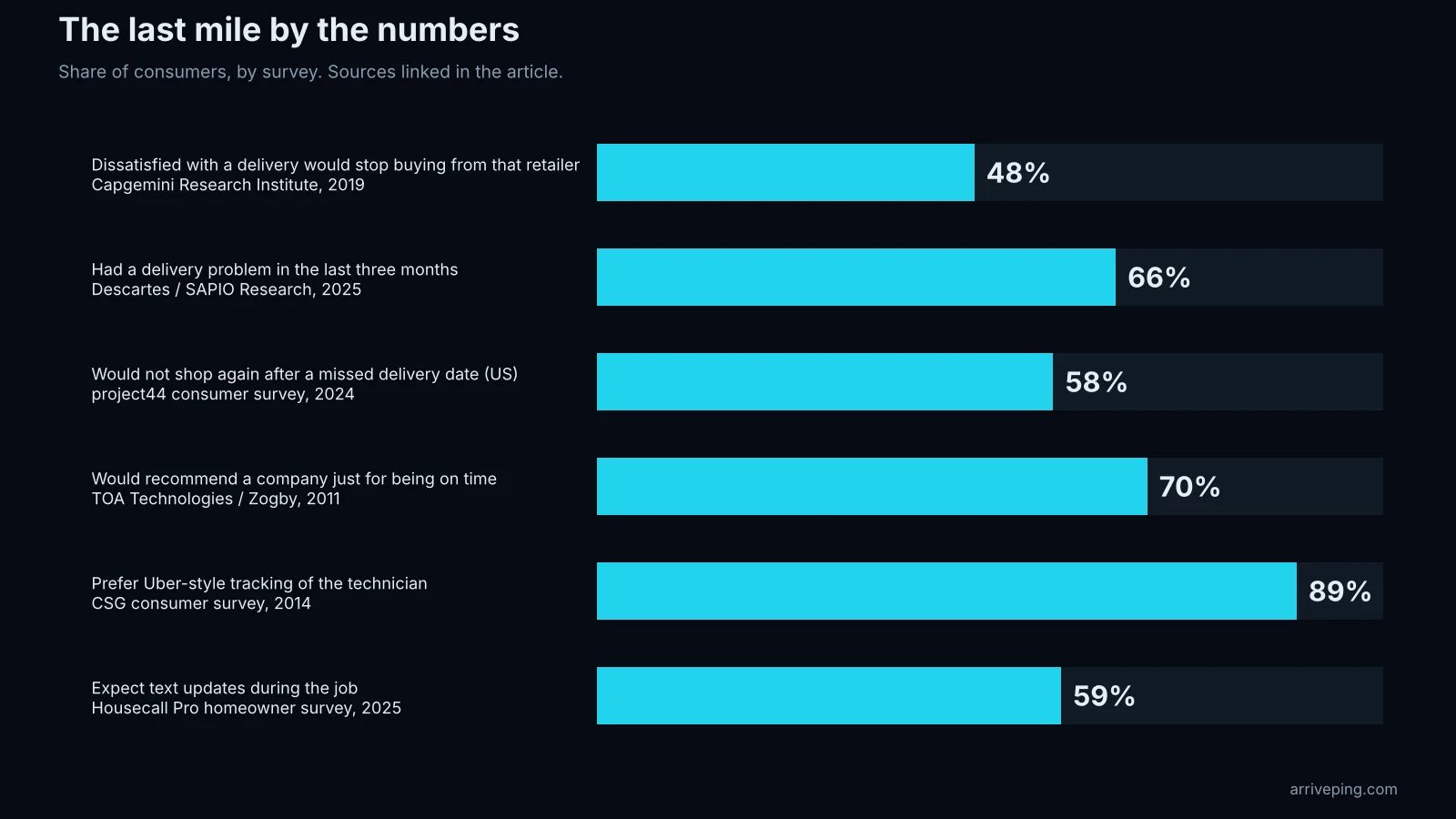
Everything a service company does before the arrival is invisible to the customer. The quote, the scheduling, the parts, the training: all of it is judged in the twenty minutes between "he should be here by now" and the knock on the door. In Capgemini's survey of 2,874 consumers, 48% of customers dissatisfied with a delivery said they would stop buying from that retailer, and the ones who stayed cut their spending by 45% (Capgemini Research Institute, 2019). Nothing about the product had changed. The last mile had.
The last mile is the final leg: the stretch from the previous stop to the customer's door. It is the most expensive part of the journey and the only part the customer experiences in person. This post sets out why that leg decides the relationship, what the research says about getting it wrong, and the Uber-style arrival that fixes it: a live ETA, a map, and a way to reach the driver when traffic turns a 2:00 arrival into 2:15.
The last mile costs the most and is judged the hardest
Logistics researchers have measured the last mile for years, and the pattern holds whether the vehicle carries parcels or a technician.
- It is the most expensive leg. The Capgemini Research Institute put last-mile delivery at 41% of total supply chain costs, more than any other stage (Capgemini via Logistics IT, 2019).
- It is where the problems happen. Descartes and SAPIO Research surveyed 8,000 consumers in Europe and North America about their deliveries in the first quarter of 2025: 66% had experienced a delivery problem in three months. The most common complaints were the delivery arriving at a different time than expected (22%) and taking longer than the customer was happy with (20%) (Descartes, 2025). Timing, not damage or cost, leads the list.
- It is where the relationship breaks. In the same study, the top three outcomes of a poor delivery were losing trust in the delivery company (22%), losing trust in the retailer (20%) and not ordering from the retailer again (19%). Only 11% of consumers under 35 said they were satisfied with the delivery process (Descartes, 2025). Descartes sells routing software; the trend matches its 2022 edition, where late deliveries (26%) and unexpected arrival times (22%) were also the top complaints (Descartes via Truck News, 2022).
- The customer blames the brand, not the driver. project44's 2024 survey of more than 1,300 shoppers found 58% of Americans unlikely to shop again with a retailer that missed a promised delivery date, and reported that shoppers hold the brand accountable even when the carrier was at fault (project44 via Retail Brew, 2024). For a service company, that is the whole point: the technician is the brand at the door.
The upside is as large as the downside. Capgemini found 74% of customers satisfied with delivery intended to increase their spending with that retailer by as much as 12% (Capgemini Research Institute, 2019).
Why one bad arrival outweighs a perfect job
The last mile carries so much weight because of how memory works, not because customers are unreasonable.
Psychologists Barbara Fredrickson and Daniel Kahneman showed that people judge an experience by its most intense moment and by how it ends, and largely ignore how long it lasted. They called the second part "duration neglect" (Fredrickson & Kahneman, Journal of Personality and Social Psychology, 1993). In a follow-up with patients undergoing medical procedures, the remembered discomfort tracked the worst moment and the final minutes, not the total (Redelmeier & Kahneman, Pain, 1996). This is the peak-end rule.
Apply it to a service call. The peak is usually the wait: the hour past the window, the second call to the office, the sense of being forgotten. The end is the arrival. If the peak was anxious and the end was a van pulling up unannounced, the customer remembers a bad experience, however well the furnace was fixed. If the peak never happened because the customer could see the van coming, and the end was a text saying "arrived," they remember a company that had it together.
The waiting data says the peak is common. The average service wait in the TOA Technologies survey was nearly four and a half hours, two and a half hours longer than expected, and half of respondents burned a sick day or vacation day to be home (TOA Technologies / IBOPE Zogby, 2011). Punctuality alone moves recommendations: 70% would recommend a company because the technician was on time, but only 43% after a 15-minute delay (CNN Money, 2011). And the day will slip: Salesforce's research with field technicians found 47% of appointments do not go as planned (Salesforce, 2025).
What customers want instead: the Uber-style arrival
Ride-share set the standard for the last mile a decade ago, and customers now carry that standard into every arrival at their door.
- See the vehicle coming. In CSG's survey of U.S. consumers, 89% preferred an Uber-like tool showing the technician's location and a continually updated arrival time, and 56% wanted an alert if the technician was running late (CSG, 2014).
- Hear from the company by text. 59% of homeowners expect text updates during a service job, and 58% want the technician's name and photo before the visit (Housecall Pro, 2025). 74% of consumers check a text notification within five minutes (SimpleTexting, 2026).
- Get a precise window, then a precise time. 18% of consumers in the Descartes study chose a precise delivery window as their top priority, ahead of speed, and inflexible delivery slots appeared on the list of problems (Descartes, 2025).
- Be told before they have to ask. Gartner's survey of more than 6,000 customers found proactive service lifted satisfaction, effort and Net Promoter scores, yet only 13% of customers had received any proactive contact (Gartner, 2020).
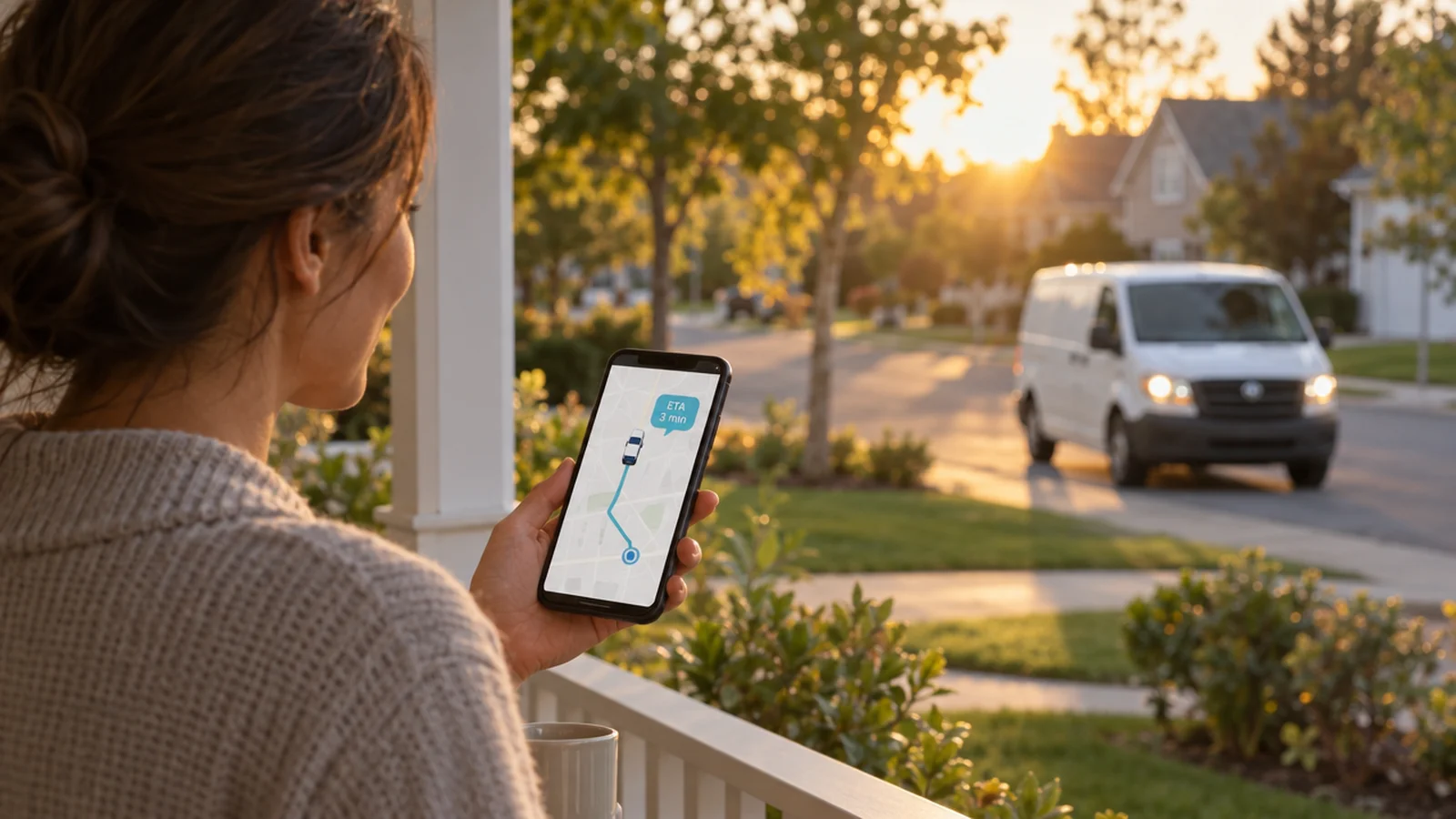
The traffic case is the one that matters most. A driver stuck behind a collision on the way to a 2:00 appointment is normal. What separates companies is what the customer experiences in the next fifteen minutes. In the silent version, the customer checks the window, calls the office, is told "he's on his way," and starts composing the review. In the Uber version, the ETA on the customer's phone moves from 2:00 to 2:15 on its own, and if they want to say "the side door is open, come straight in," they tap Text and the driver gets it. The delay is identical. The memory of it is not.
The last-mile playbook
- Confirm the night before with a two-hour window. Narrow the window once the route is known. A window the customer can plan around removes most of the anxiety before the day starts.
- Send the on-my-way text with a live link when the driver leaves the previous stop. This single message replaces the "where are you" call, because the customer can answer it themselves.
- Let the ETA move on its own. Traffic, a long previous job, a wrong turn: the map should absorb all of it. The customer should never learn about a delay by waiting.
- Give the customer a direct line to the driver. Text and call from the tracking page, not through a switchboard. Gate codes, parking, a dog in the yard and "I'm running to the store, back in ten" all get handled in one message.
- Confirm arrival and completion. The end of the experience is what gets remembered. An "arrived" notice and a completion note with what was done close the loop and set up the review request.
- Measure the last mile, not just the job. Track on-time arrival against the promised window, the share of jobs with a live link opened, and inbound "where are you" calls per job. If the third number is not falling, the first two are not working.
How ArrivePing handles the last mile
ArrivePing was built around the arrival, because that is where field service companies win or lose the customer.
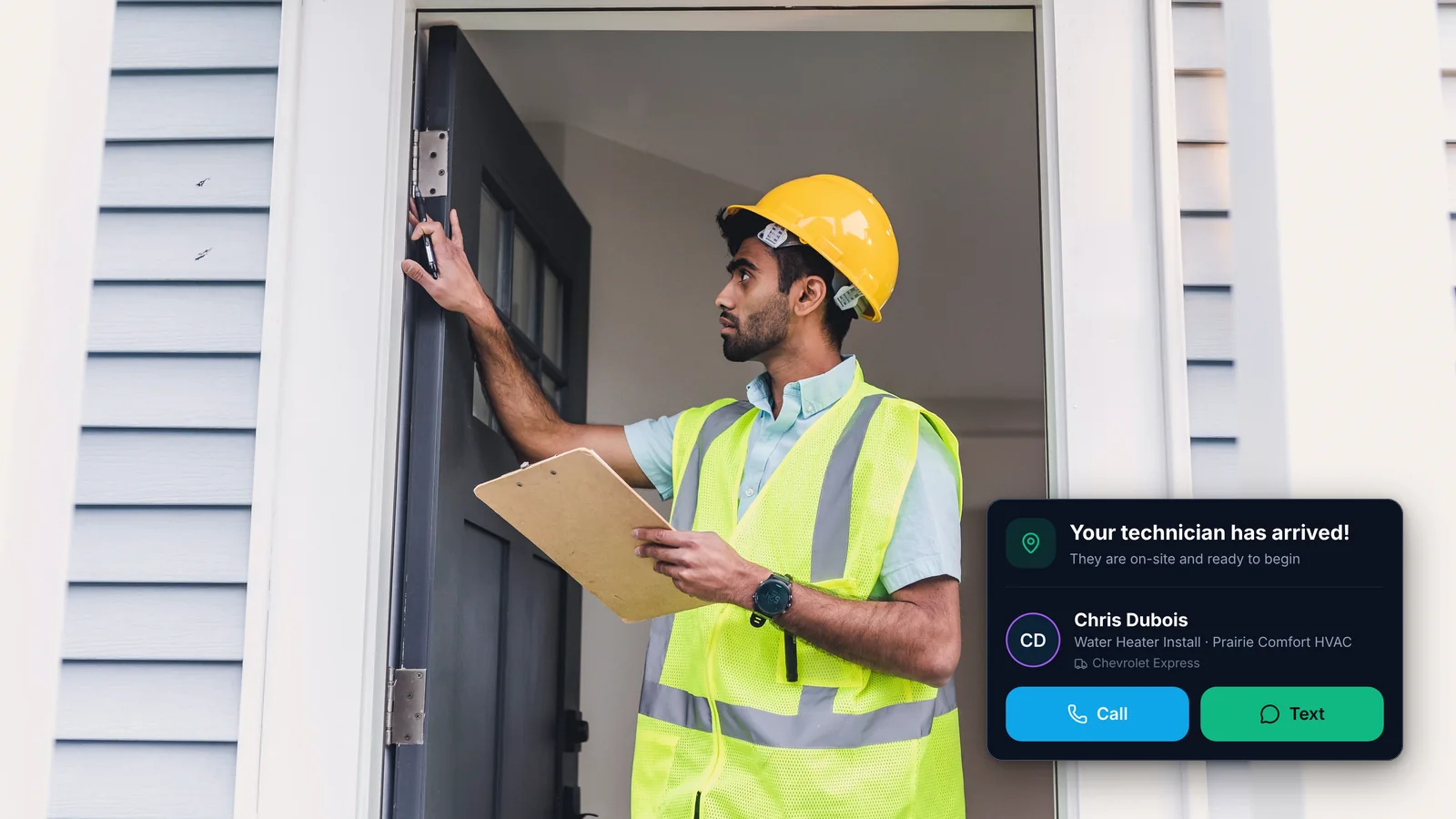
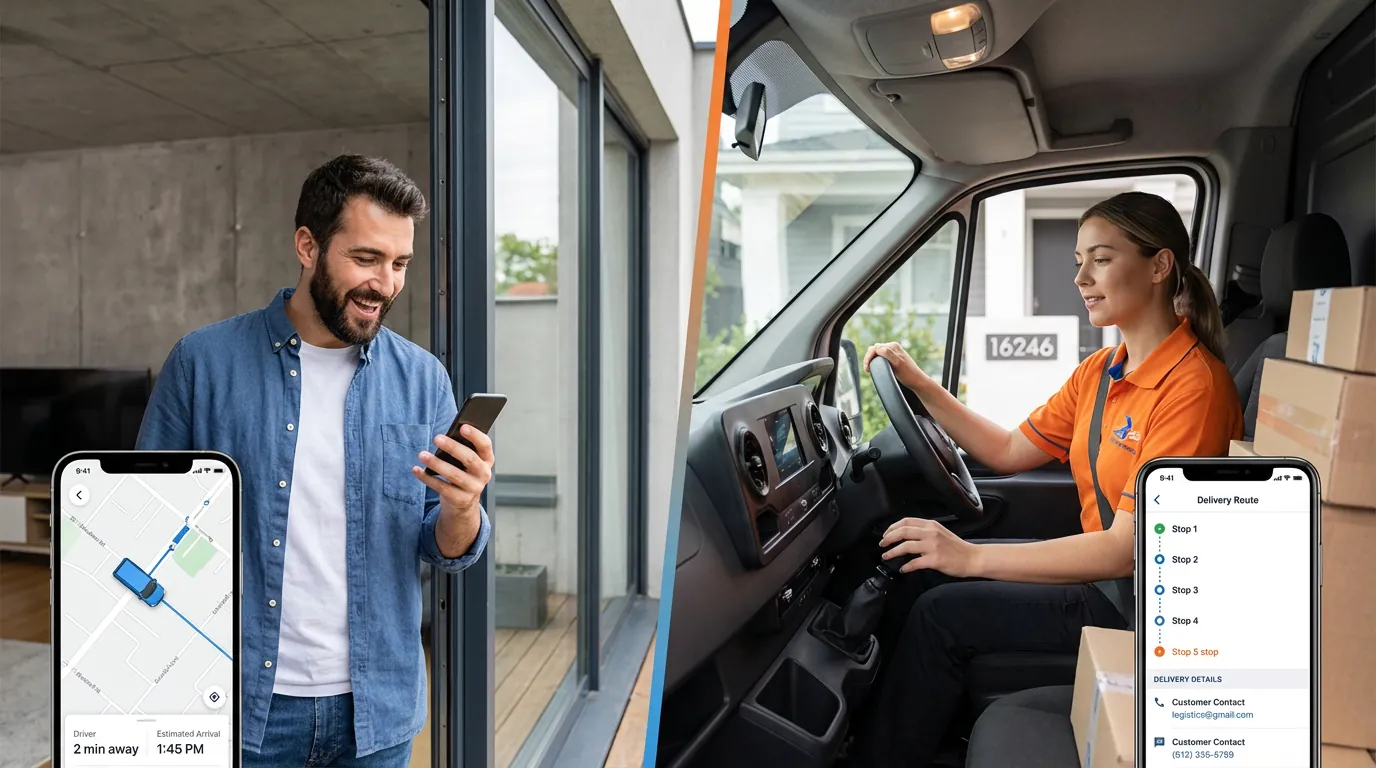
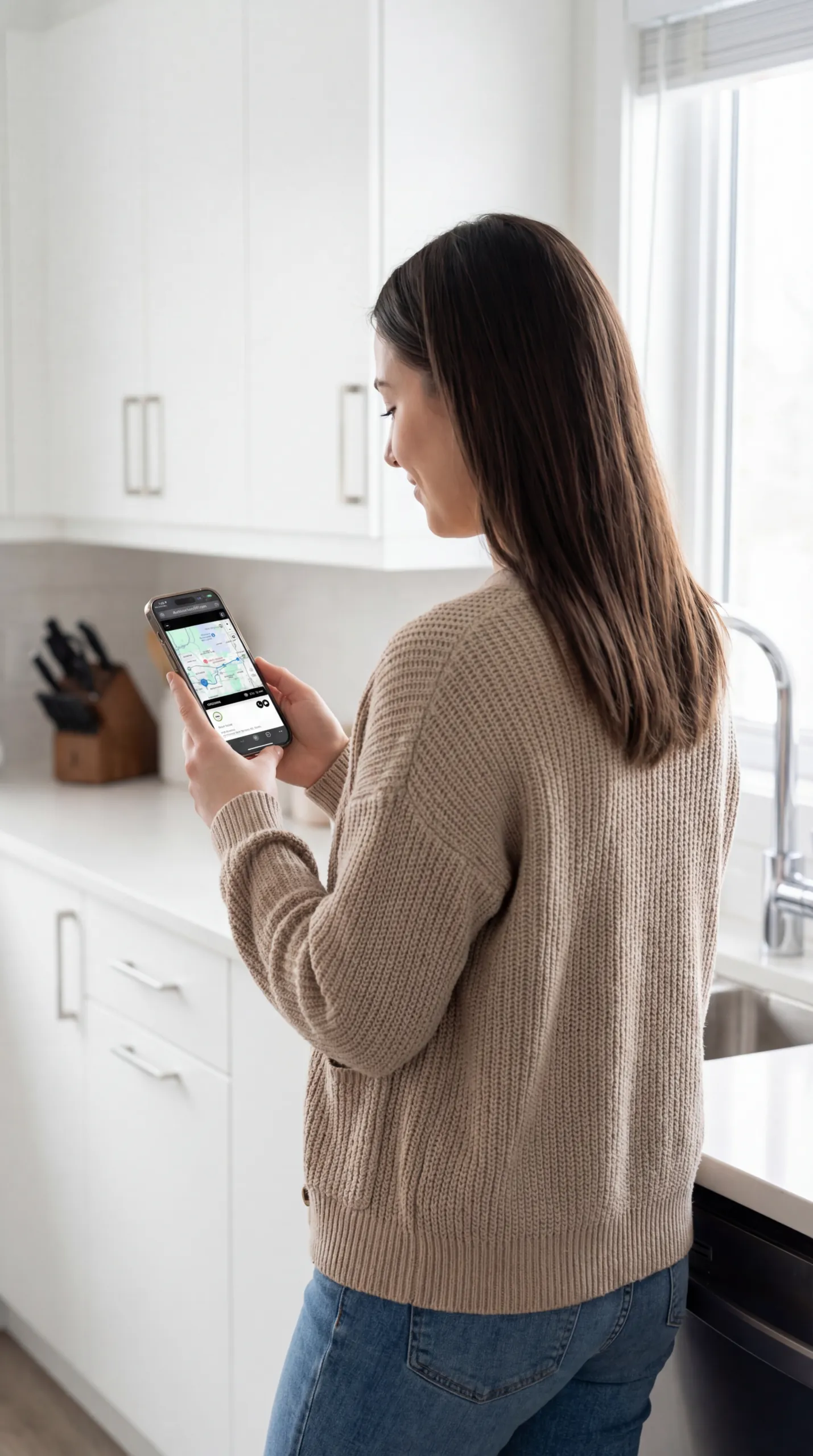
- Every job sends an on-my-way text with a live tracking link. The customer sees the technician or driver on a map with an ETA that updates as the vehicle moves, and can text or call them straight from the page. No app for the customer to install.
- Dispatchers see every technician and driver on one live map and ArrivePing auto-assigns the closest qualified person to each job, which keeps the last mile short and the window narrow. Details on the customer notifications page.
- A geofence confirms arrival and starts the on-site clock, so the office knows the moment the technician is on site.
- It works for appointment-based delivery and installation teams as well as service trades; see delivery dispatch software.
For the full cost of an arrival that goes silent, read No Call, No Show. For why a low-friction arrival lowers acquisition cost over time, read Become the Preferred Provider.
FAQ
What is the last mile in field service?
The last mile is the final leg of a job: the trip from the technician's or driver's previous stop to the customer's door, and the arrival itself. It is the only part of the service the customer experiences in person, and surveys consistently show that arrival timing, not price or product, is the most common source of complaints.
Why does a late arrival hurt more than other problems?
Because of how people remember experiences. Research by Fredrickson and Kahneman shows people judge an experience by its most intense moment and its ending, and largely ignore duration. For a service call, the most intense moment is usually the wait and the ending is the arrival, so a long, silent wait defines the memory even when the work was excellent.
What should a customer see while the technician is on the way?
A live map with the vehicle's position, an ETA that updates automatically as traffic changes, the technician's name and photo, and buttons to text or call the technician directly. Surveys show 89% of consumers prefer this Uber-style view and 56% want an alert if the technician is running late.
How do you handle a technician who is stuck in traffic?
The customer's ETA should update on its own, so they see the new time before they notice the old one has passed. If the delay will push past the promised window, send a short text with the new time and let the customer reply or call the technician directly. A delay that is communicated before the customer asks is remembered as good service; the same delay discovered by waiting is remembered as a bad one.
Sources
- Capgemini Research Institute, The Last-Mile Delivery Challenge press release (January 2019); cost figure via Logistics IT
- Descartes Systems Group / SAPIO Research, 2025 Ecommerce and Home Delivery Consumer Sentiment Study (2025) and 2022 edition via Truck News
- project44, State of Consumer Holiday Shopping 2024 via Retail Brew (2024)
- Fredrickson & Kahneman, Duration neglect in retrospective evaluations of affective episodes, Journal of Personality and Social Psychology (1993)
- Redelmeier & Kahneman, Patients' memories of painful medical treatments, Pain (1996), summarized at Peak–end rule
- TOA Technologies / IBOPE Zogby, Cost of Waiting survey (2011) and CNN Money (2011)
- Salesforce, Field service scheduling research (2025)
- CSG International, Survey results on in-home customer service (2014)
- Housecall Pro, Home Service Customer Service Report (2025)
- SimpleTexting, 2026 Texting & SMS Marketing Statistics
- Gartner, Organizations need to move from reactive to proactive customer service (2020)