The Uber Effect: Why Less Friction Wins More Business Than a Better Price
How Uber beat taxis on ease rather than price, what ride-hailing data shows about trust and price shopping, and how field service firms can cut friction.
Here’s a Question Nobody Can Answer
When was the last time you opened your Uber app, saw the price, then pulled up a taxi company’s number to compare rates before booking?
If you’re honest with yourself — never. Or close to it.
And that’s the entire point.
Uber didn’t beat the taxi industry on price. In many markets, Uber is more expensive. They didn’t have more experienced drivers. They weren’t backed by decades of infrastructure and licensing. They won by making the entire experience so frictionless, so transparent, so easy — that the price comparison conversation simply stopped happening.
That is the Uber Effect. And it’s the most powerful force in modern business that most service companies are still completely ignoring.
What Friction Actually Costs You
Before we talk about what Uber built, let’s talk about what traditional taxis failed to fix.
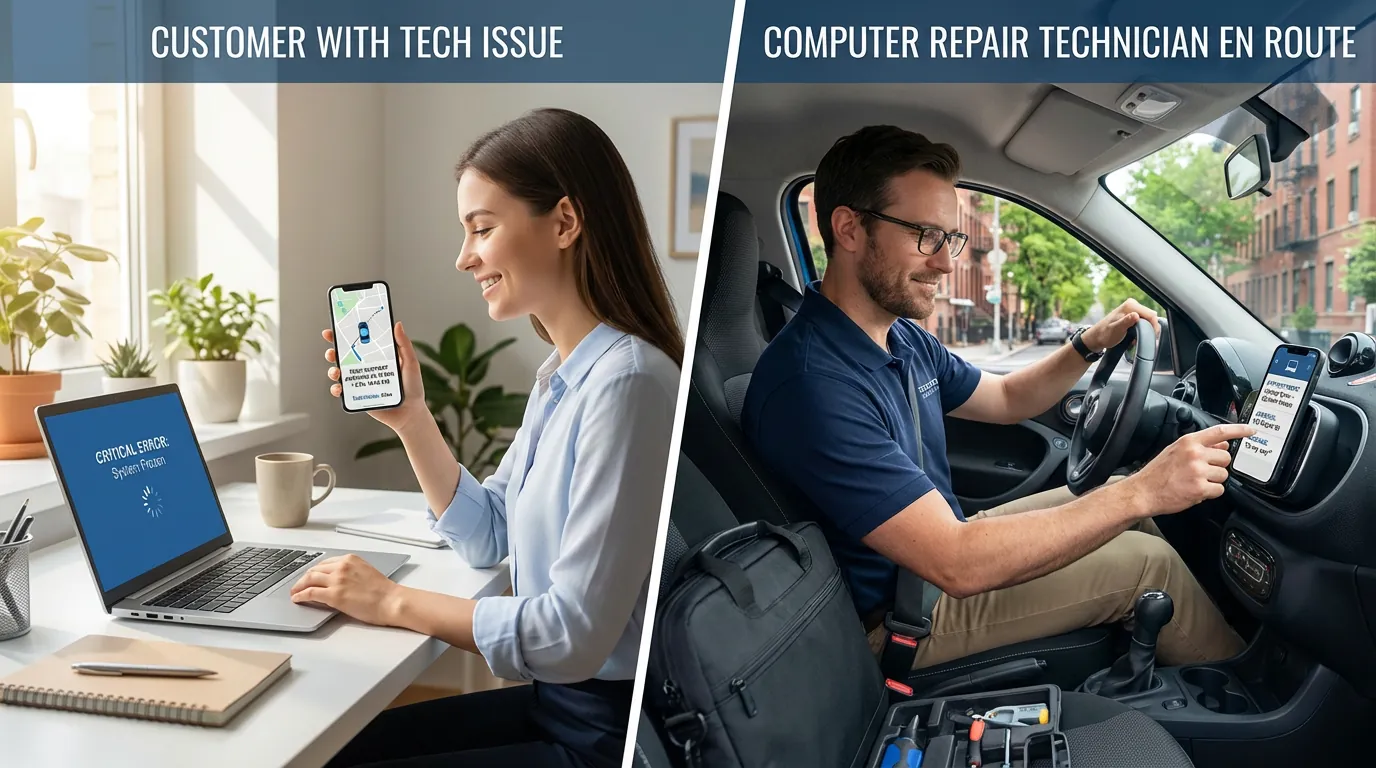
Booking a cab meant calling a number, waiting on hold, getting a vague “20-30 minute” window, standing on a corner with no idea if the car was coming, paying cash, and hoping the driver knew the route. Every single step was laced with uncertainty, inconvenience, and anxiety.
That anxiety is friction. And friction is expensive — not just to the customer, but to the business.
In the field service world, the cost is just as real. Every year, homeowners and facility managers lose a huge number of hours waiting for service appointments with no visibility into when their technician will arrive. That’s not a small inconvenience — it’s a systemic failure baked into an entire industry’s operating model.
The result? Clients call and ask “where is your guy?” over and over again. Dispatchers spend half their day fielding status update calls instead of routing jobs. And your brand is quietly associated with frustration — even when your work is excellent.
How Uber Rewrote the Rules
In 2010, Uber launched with a deceptively simple idea: let people see exactly where their driver is, know exactly when they’ll arrive, and pay automatically without the awkward cash transaction at the end.
That’s it. That was the product.
The results were not subtle. By 2024, Uber commanded 75% of the U.S. ride-hailing market, completing 11.3 billion trips globally with 161 million monthly active users across 70+ countries. Meanwhile, traditional taxi revenue is projected to drop below $19 billion by 2029, while ride-hailing surges toward $61 billion. Statista
In New York City alone — arguably the world’s most taxi-friendly city — Uber and Lyft now handle 676,000 trips per day. Yellow cabs? 113,000. That’s a 6-to-1 ratio in a city where taxis had a century-long head start. ElectroIQ
Uber didn’t win that market through discounting. They won it by making the competition irrelevant.
The Proof: Nobody Compares Prices When the Experience Is Good Enough
Here’s the data point that should stop every business owner cold.
A 2025 study by the National Bureau of Economic Research analyzed 2,238 matched rides in New York City comparing Uber and Lyft prices for identical routes. The average price gap between the two platforms was 14% — roughly $3.50 per ride. Real money, every trip.
And yet? Rideshare users only comparison-shopped between platforms 16% of the time. NBER
Eighty-four percent of users just hit “book” on whichever app they trusted most and opened first.
Think about that. Despite a consistent, measurable price gap that adds up to hundreds of dollars per year — the vast majority of consumers actively chose not to engage with the price conversation at all. Why? Because the experience was good enough to eliminate the hesitation. The trust was high enough to bypass the calculation.
This is what great user experience actually does: it doesn’t just make people happier — it removes price sensitivity from the decision entirely.
Research backs this up across industries. According to Salsify, 87% of consumers will pay more for a brand they trust. Forrester Research found that well-designed UX can improve conversion rates by up to 400%. And studies on digital friction show that reducing hesitation by even a fraction of a second can lift conversions by 8.4%. Forrester via Modern.tech
The correlation is unambiguous: trust kills price sensitivity. Friction destroys trust. Therefore, reducing friction is one of the highest-ROI moves any business can make.
The Taxi Industry Had Every Advantage. And Still Lost.
This is the part that should make every established service business deeply uncomfortable.
Taxis had:
- Decades of brand recognition
- Regulatory protection in every major city
- Established infrastructure and fleets
- Experienced, licensed professional drivers
- The home turf advantage in every market they operated
Uber had: a better app.
That is not an oversimplification. It is the lesson. The taxi industry assumed that structural advantages — licensing, regulation, familiarity — would protect them from a software company. They were catastrophically wrong.
The companies that are going to lose market share in the next decade aren’t going to lose it because a competitor is cheaper or technically superior. They’re going to lose it because someone else made the same service easier to buy, easier to trust, and easier to experience.
The question for every field service business right now is: are you the taxi, or are you building the Uber?
The Uber Effect in Field Service: Your Industry Is About to Change
The field service industry — construction, HVAC, plumbing, electrical, property management, logistics — is currently sitting exactly where the taxi industry was in 2009. Highly fragmented. Dependent on phone calls. Operating on the infamous “4-hour window.” Delivering service with almost no real-time transparency for the client.
And clients are tolerating it. For now.
But the moment a competitor in your market gives clients live technician tracking, automated ETA updates, and instant digital communication — the same psychological shift that happened with ride-hailing will happen in your space. Clients won’t go back to the old experience. Not for a lower price. Not for longer tenure. Not for anything.
What clients actually want is clear:
- Clients notice live technician tracking. It still stands out in most trades, so it gets talked about.
- Miscommunication drives rework — the kind that vanishes when clients and technicians are aligned in real time.
- When friction is removed from the service experience, inbound “where is my tech?” calls fall — freeing dispatchers to route more jobs rather than manage anxiety.
The companies winning field service contracts in 2025 and beyond won’t win them by being 10% cheaper. They’ll win them by being the only option that makes clients feel informed, respected, and confident — from booking to completion.
What “Uberizing” Your Business Actually Looks Like
The Uber model wasn’t magic. It was a specific set of friction points identified and eliminated, one by one:
| Old Friction Point | Uber’s Fix |
|---|---|
| “When will my driver arrive?” | Live GPS tracking on screen |
| “Will they find me?” | Mutual real-time location sharing |
| “How much will this cost?” | Upfront price before booking |
| “Do I need cash?” | Automatic card payment, no interaction needed |
| “Was I safe?” | Driver rating system and trip records |
Every one of these friction points has a direct equivalent in field service:
| Field Service Friction Point | ArrivePing’s Fix |
|---|---|
| “When will the technician arrive?” | An on-my-way text or email with a live tracking page and ETA when the tech heads out |
| “Who is coming, and how do I reach them?” | The tracking page shows the technician’s progress, with text and call buttons |
| “Has the job started?” | Geofenced arrival and an on-site time clock record when the technician is on site |
| “What was done on site?” | Job photos and the invoice stay tied to the work order |
| “Why did costs go over?” | On-site time is recorded automatically, so there is a clear record to point to |
The experience your clients have between “job booked” and “job completed” is your product. Not just the work itself. The experience of the work is what they’ll remember, what they’ll refer, and what they’ll pay a premium to keep.
The Compounding ROI of a Better Experience
Here’s the business case, clean and direct:
When friction goes down, trust goes up. When trust goes up, clients stop price-shopping. When clients stop price-shopping, your margin expands — not because you raised prices, but because you stopped competing on them.
Additionally:
- Fewer “where is my tech?” calls = fewer hours of dispatcher time burned on non-revenue activity
- Real-time job documentation = fewer disputes, faster invoicing, faster payment
- Transparent communication = fewer complaints, more referrals, better reviews
- Clients who feel informed = clients who renew contracts, not clients who shop around
The aim is to run the same team more efficiently, not to pay techs less: more jobs completed per day, less time wasted on coordination calls, more margin per job, without touching your rate card.
That’s the compounding ROI of eliminating friction. You get paid more to do the same work — because clients trust you more, waste less of your time, and never have a reason to look elsewhere.
The Window Is Open. It Won’t Stay That Way.
Here’s the honest reality: the companies that move first on client experience in field service will build the same kind of moat Uber built in ride-hailing. The second-mover advantage in this space is thin.
When your client has experienced live technician tracking, they will expect it from everyone they hire. When your competitor implements it first and your client experiences the contrast, that conversation becomes very difficult to win back on price alone.
The taxi industry had years of warning. They watched Uber grow. They chose to lobby regulators instead of improving the experience. The market made the decision for them.
You don’t have to make the same mistake.
Bringing the Uber Experience to Your Field Service Business
ArrivePing was built by the team at NVC360, operators who managed 800+ field technicians and experienced the friction firsthand — from both sides of the dispatch desk and the client relationship. It is designed to close the communication gaps that erode trust, inflate costs, and put margin at risk.
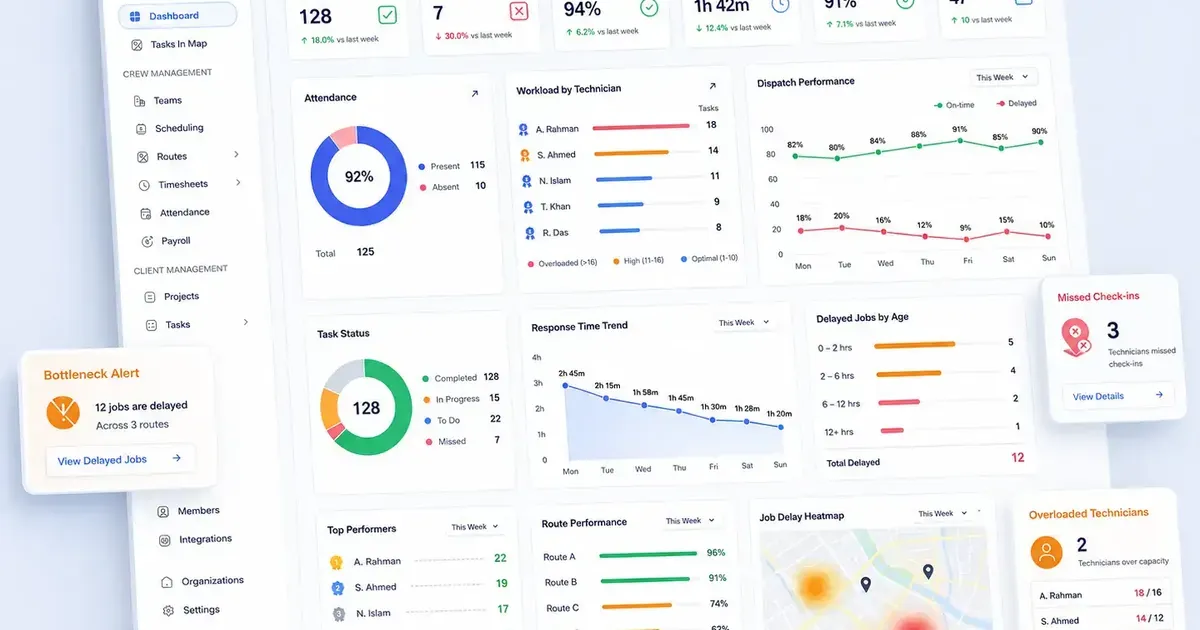
A live map of your technicians. On-my-way texts with a live ETA, and a running-late notice when a job slips. Job photos and invoicing. Exports, webhooks, Zapier and Make so it works alongside the tools you already use. No vehicle GPS hardware to install, and most teams dispatch their first job within an hour.
ArrivePing launches in November 2026. The Uber Effect is coming to field service; the only question is whether you’re delivering it or watching a competitor do it first.
See how ArrivePing works for your team: book a demo.