How to Become a Preferred Vendor: Why Convenience and Frictionless Communication Kill Price Sensitivity
Research from PwC, 6sense and Gartner on why convenience and low-effort communication win repeat work, and how field service teams can lower price pushback.
Price Is Not the Problem. Experience Is.
Every business owner in the field services and construction world has heard the same objection: “Your price is too high.”
Here’s the truth: in most cases, price isn’t actually the problem. Experience is.
When clients say they’re choosing a competitor based on price, what they often mean is that you haven’t given them a compelling enough reason to justify your rate. You haven’t made working with you feel effortless, certain, and premium. You haven’t become their preferred vendor.
The research on this is overwhelming. According to PwC’s landmark Future of Customer Experience survey, 86% of buyers are willing to pay more for a great customer experience. That’s not a niche finding — it’s a fundamental truth about how humans make purchasing decisions. And it has enormous implications for field service businesses competing on something other than being the cheapest option in the market.
The businesses that understand this — and act on it — become preferred vendors. They win repeat business automatically, receive referrals consistently, and command premium pricing without resistance.
This article explains how supreme convenience and frictionless communication create that preference — and how ArrivePing by NVC360 is built to make it part of your daily operation.
What a Preferred Vendor Actually Is — and Why It Matters
A preferred vendor isn’t just a supplier that gets repeat business. It’s a business that has become the default choice — the company a client reaches for before they’ve even begun evaluating alternatives.
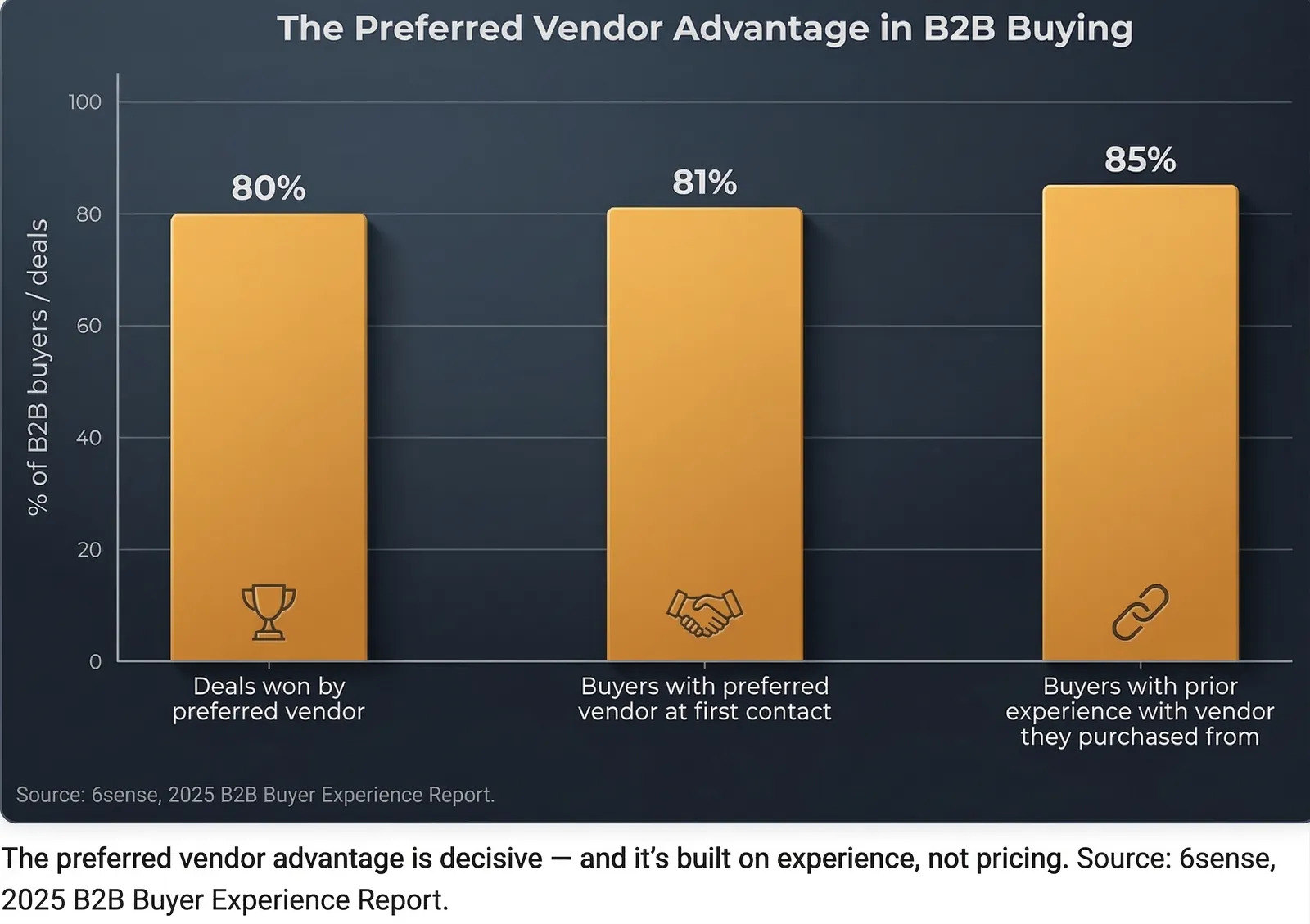
The scale of this advantage in B2B markets is staggering. According to 6sense’s 2025 B2B Buyer Experience Report — one of the most comprehensive studies of modern purchasing behavior — 80% of B2B deals are won by the vendor the buyer preferred before they ever spoke to a sales rep.
Let that land for a moment. Four out of five deals are effectively decided before the formal buying process even begins. Sellers, in most cases, are not changing minds — they are confirming decisions already made.
The same study found that 81% of buyers already have a preferred vendor in mind at the moment they make first contact, and 85% had prior direct experience with the vendor they ultimately purchased from. The buying journey, in other words, is not a process of discovery — it is a process of confirmation.
What this means for field service businesses — home services, construction, specialty trades, limousine services, home care — is profound: the best sales strategy is not a better pitch. It is a better experience. Win the experience, and the next sale is already yours before it begins.
Convenience Is a Price Reducer — For Your Competitor
PwC asked consumers directly: what would make you willing to pay more? The answers are a blueprint for any field service business that wants to own its market.
- 43% of consumers would pay more for greater convenience
- 42% would pay more for a friendly, welcoming experience
- 52% would pay more for a speedy and efficient service
- 86% would pay more for an overall great experience (PwC)
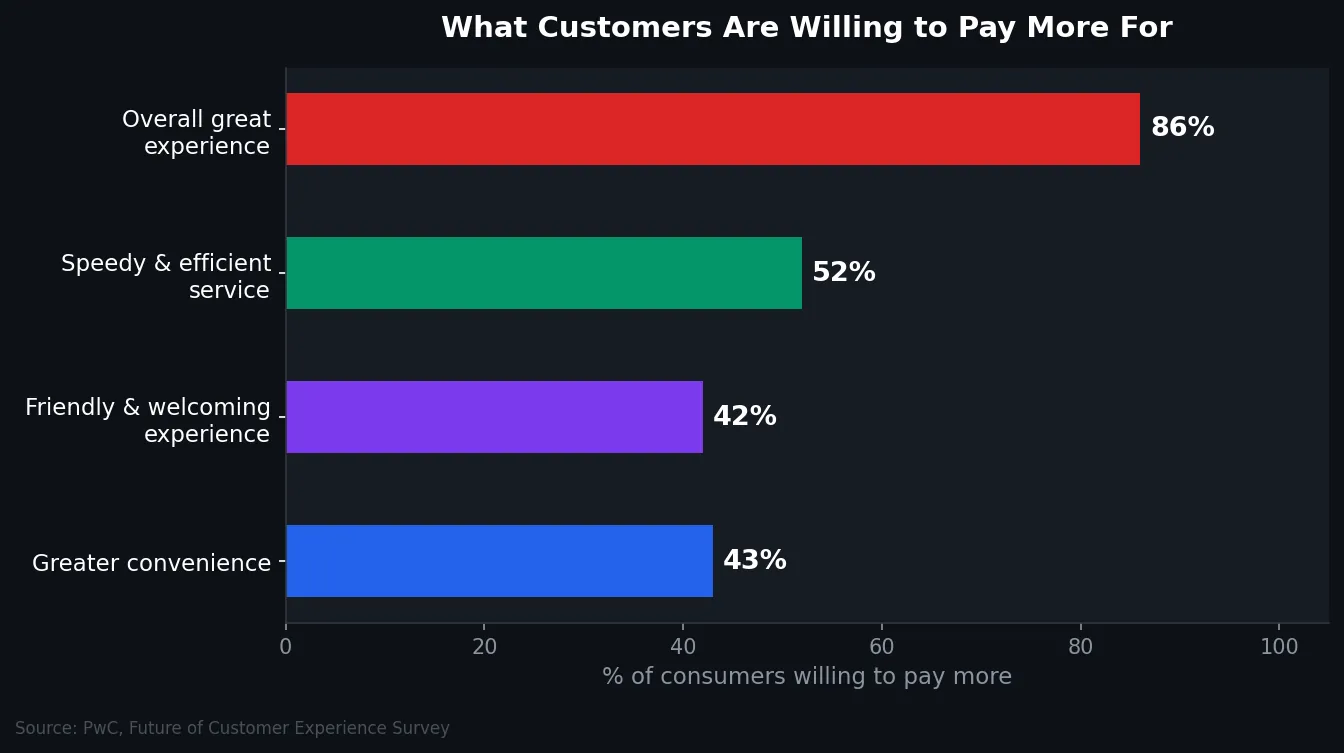
Consumers are explicit: they’ll pay more for convenience, speed, and great experiences. Source: PwC, Future of Customer Experience Survey.
Notice what’s not on that list: a lower price. Clients don’t lead with price when they’re being served well. Price becomes the conversation only when experience fails to differentiate.
Qualtrics reinforces this from a different angle: 72% of U.S. consumers say they would pay more for a premium experience when doing business with a company (Qualtrics XM Institute). And Invoca puts the premium potential at 16% above standard pricing for a genuinely great customer experience.
The inverse is equally powerful. When your competitor offers a lower price but a worse experience, they are not taking your client — they are temporarily borrowing a customer who will eventually return to whoever makes their life easiest. Convenience, done consistently, builds a moat that price cannot cross.
The Science of Frictionless: Why Effort Kills Loyalty Faster Than Anything Else
The most important insight in the last decade of customer experience research didn’t come from a study about delight or satisfaction. It came from a study about effort.
Researchers at Gartner and CEB found that the single strongest predictor of customer disloyalty is not a bad product — it is a high-effort experience. In their landmark research on the Customer Effort Score (CES), they found that 96% of customers who experienced a high-effort interaction became disloyal, compared to only 9% of customers who experienced a low-effort interaction (SI-Labs summary of the CEB research).
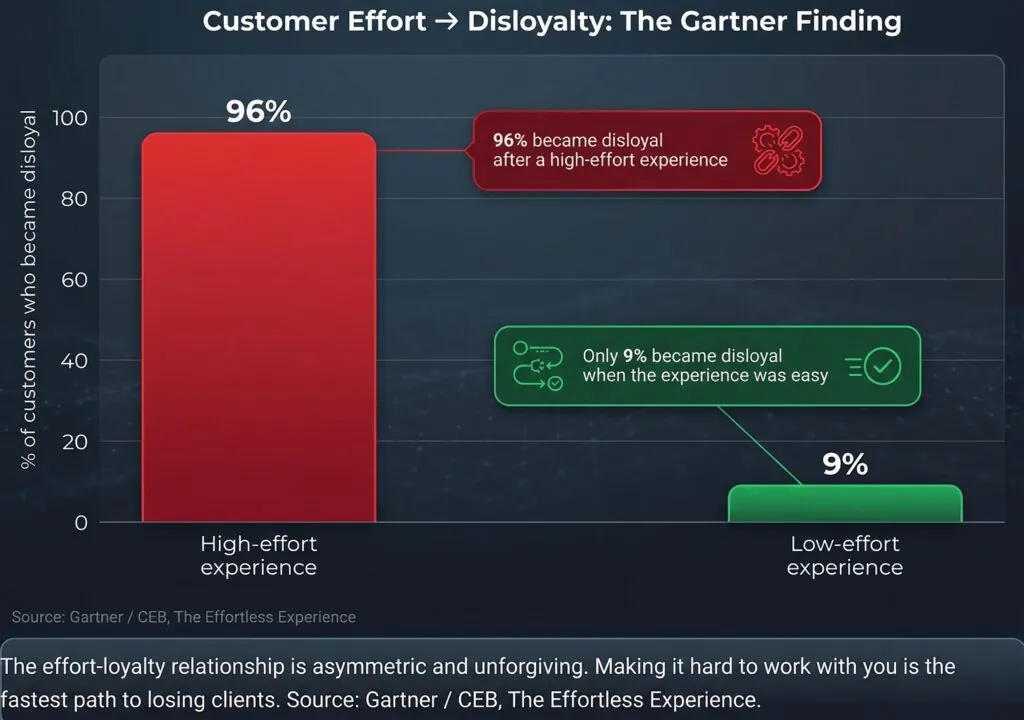
That’s not a marginal difference. That’s a 10-to-1 ratio. Making a client work hard — to track down an ETA, to call dispatch repeatedly, to follow up on a job status, to chase a technician — doesn’t just frustrate them. It systematically dismantles their loyalty, regardless of how good the actual work was.
Gartner’s further research found that companies who make interactions genuinely easy are 94% more likely to win repeat business (via LinkedIn). And according to Forrester, 77% of consumers say that valuing their time is the single most important thing a company can do to provide a great service experience (cited by Qualtrics).
Time. Effort. Clarity. These are the currencies of the modern service economy — and they cost nothing to provide when your operations are built for it.
What “Friction” Looks Like in Field Service
In field service operations, friction isn’t abstract. It has a face. It sounds like:
- “I’ve been waiting three hours. Can you tell me when your technician will arrive?”
- “Nobody told me the job scope had changed.”
- “I’m getting different information from your technician and your office.”
- “I had to follow up twice to get a confirmation.”
- “Your crew showed up but didn’t have the right parts because the work order was wrong.”
Every one of those statements is a loyalty-destroying event — and every one of them is a communication failure masquerading as a service failure.
Communication Is the Product
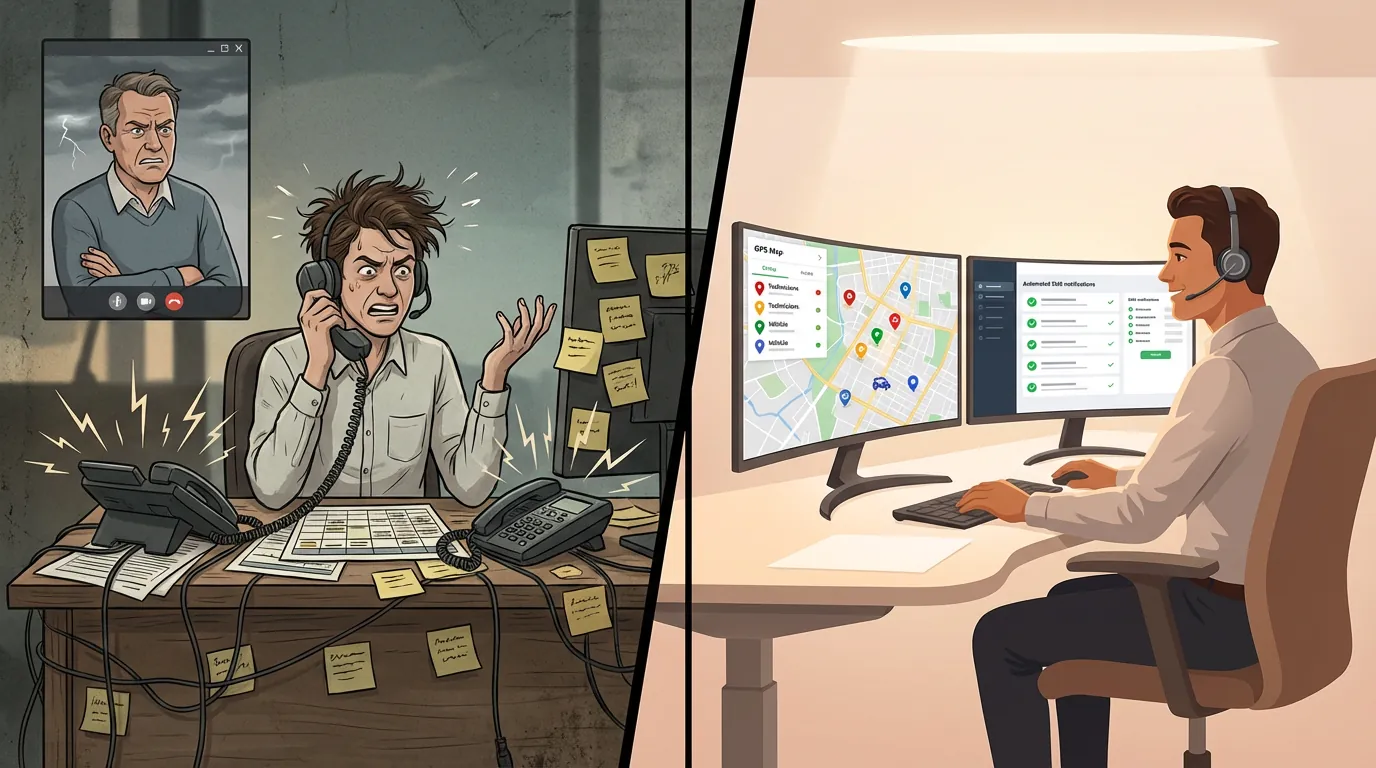
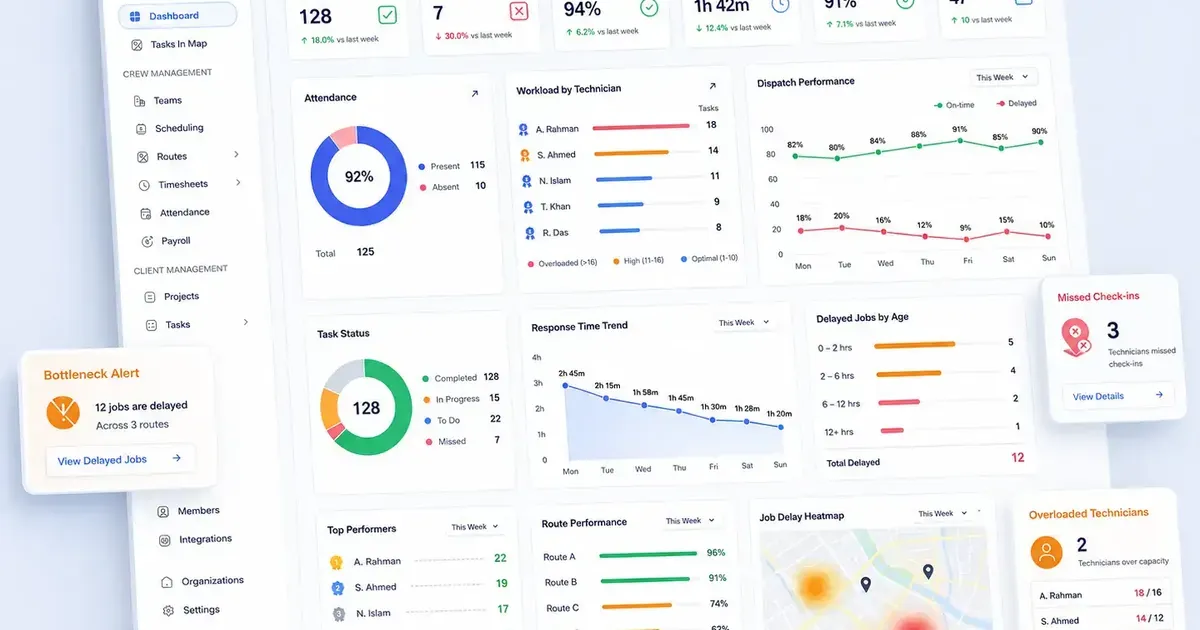
Left: the communication chaos that erodes trust and loyalty. Right: the frictionless, real-time operation that creates preferred vendor status.
Here is a counterintuitive truth that the best field service operators understand: your clients don’t just buy your service. They buy the experience of being served.
A homeowner waiting for an HVAC technician isn’t evaluating your refrigerant technique. They’re evaluating whether you showed up on time, whether they knew you were coming, whether the tech was professional, and whether the whole interaction felt easy. That evaluation determines whether they call you back or search for a competitor next time.
According to the Salesforce State of the Connected Customer report, 80% of customers say the experience a company provides is as important as its products and services. Not more important than — equally important as. The work and the experience are weighted the same.
And yet most field service businesses invest almost entirely in the technical side — training, tools, certifications — and almost nothing in the communication infrastructure that determines how the client experiences the service they’ve paid for.
Proactive Communication: The Highest-ROI Move in Field Service
The most powerful shift a field service business can make is moving from reactive communication to proactive communication. Reactive communication responds to a client’s question. Proactive communication answers it before they ask.
The operational data on this is striking:
- Proactive ETA notifications have been shown to reduce inbound “where is my technician?” calls by 60–73%, freeing dispatch teams to focus on operations rather than fielding status inquiries (FieldProxy; Numa).
- Research shows that proactive communication reduces customer complaints by 40% and increases customer satisfaction scores by 85% (nShift).
- Improving ETA accuracy from a ±60 minute window to ±15 minutes has been shown to raise customer satisfaction scores by 8–12 percentage points in field service operations (TradeWork Site).
Think about what this means financially. Every inbound “where is my tech?” call costs your office staff time. Eliminating 60–70% of those calls is not just a client experience improvement — it is a direct operational cost reduction. The experience upgrade and the cost reduction are the same action.
The Retention Multiplier: Why Preferred Vendors Are More Profitable, Not Just More Popular
Becoming a preferred vendor isn’t just a reputation achievement — it is a profitability strategy. The financial math is unambiguous.
Research consistently shows that acquiring a new customer costs 5–25 times more than retaining an existing one, depending on industry and business model (Genesys Growth). And according to Bain & Company, a 5% increase in customer retention rates produces a 25–95% increase in profits (cited by Churnkey).
The businesses that retain clients effortlessly are the ones that made becoming a repeat customer feel natural — not a decision that required active re-evaluation. That only happens when the experience was so smooth, so reliable, and so clearly superior to what a competitor could offer that switching feels like a downgrade.
There is also a review dynamic that amplifies the preferred vendor effect. According to BrightLocal’s research, 89% of U.S. shoppers read online reviews before making a purchase decision, and 94% say a negative review has convinced them not to use a business (InMoment; Hook Agency). The field service businesses that dominate local markets almost always dominate local reviews — not because every job goes perfectly, but because proactive communication preempts the frustrations that generate negative reviews in the first place.
A client who got a heads-up with a live tracking link when the technician was on the way, knew their tech’s name before the doorbell rang, and got a clear digital summary of the work completed — that client doesn’t write a complaint. They write a five-star review.
Price Sensitivity Drops When Preference Is Established
Here’s the mechanism that makes all of this financially transformative: when a client has a preferred vendor, they stop shopping on price.
This is not anecdotal. It is a well-documented behavioral economics principle backed by decades of brand loyalty research. When a buyer has a trusted, proven relationship with a vendor, the cognitive cost of switching — re-evaluating, re-onboarding, accepting uncertainty about quality and reliability — becomes higher than the perceived savings from a cheaper alternative.
PwC’s 2025 Customer Experience Survey found that more than half of consumers (52%) stopped using a brand after a bad experience — but the inverse is equally true. Customers who have consistently good experiences develop inertia in your favor. They don’t research alternatives. They don’t respond to competitor ads. They call you first, accept your quote, and schedule the job.
This is how a field service business moves from competing on price to competing on preference — and why companies that achieve preferred vendor status in their markets often carry higher margins than their peers while maintaining higher client retention rates simultaneously.
How ArrivePing Operationalizes Preferred Vendor Status
Everything described above — proactive communication, frictionless experience, reduced client effort, real-time transparency — requires operational infrastructure. You cannot deliver an Uber-like client experience on a foundation of phone calls, text threads, and manual dispatch. The experience has to be built into the system.
That’s what ArrivePing was built to provide. It comes from the team at NVC360, who ran more than 800 field technicians, so it is not a theoretical platform — it is a system designed around the real operational failures that destroy client relationships and prevent field service businesses from achieving preferred vendor status.
1. The Uber-Like Client Experience — Automated
When a technician heads out, ArrivePing automatically sends the client an on-my-way text or email. The message includes a link to a live tracking page that shows the technician’s progress and ETA, with buttons to text or call. If the job slips, the client gets a running-late notice. The client knows who is coming, when they’ll arrive, and how to reach them — without making a single call to your office, and without downloading an app.
This is the single highest-leverage client experience improvement a field service business can make — and ArrivePing delivers it automatically, on every job, without any additional effort from your team.
2. Real-Time Dispatch Visibility — Eliminating the Coordination Friction
A live map shows every active technician and driver in real time, using the technician app on their phone — no vehicle hardware required. Dispatchers have full visibility in a single view. Jobs can be reassigned in a few clicks. There are no calls to locate technicians, no uncertainty about estimated arrival times, and no gap between what dispatch knows and what the client is being told.
Internally, this eliminates the friction that creates inconsistency. Externally, it creates the seamless experience that generates preferred vendor status. Both outcomes come from the same system.
3. Complete Job Information on Every Device
Every work order carries the job type, priority, time window, required skills, access notes, and photos — all in the technician app on iOS or Android. No chasing paperwork. No calling the office to confirm job details. No arriving on-site without the context needed to do the job right the first time.
This matters because companies with a first-time fix rate above 70% achieve customer retention rates of 86% (Fiesa; CompareSoft). First-time fix rates depend heavily on how well technicians are informed before they arrive. Complete work orders help close that gap.
4. Clean Job Closure — Professional From Start to Finish
Arrival is recorded automatically when the technician enters the job site’s geofence, and on-site time is clocked from there. Job photos stay attached to the work order, and the invoice goes out from the same system. Clients get a clear record of what was done. There’s less ambiguity, fewer disputes, and no “we’ll send the paperwork later.”
This is the final touchpoint of every job — and it reinforces the same message as every touchpoint before it: this company has its act together. They’re the ones I call next time.
The efficiency and the client experience are not trade-offs. They are the same outcome delivered by the same system.
Which Businesses Benefit Most
The preferred vendor dynamic plays out in every market where clients have options and repeat business is valuable. But it is most powerful — and most immediately actionable — for field service businesses where the client experience is dominated by communication touchpoints.
- Home service businesses (HVAC, plumbing, electrical, cleaning, landscaping) — where the 4-hour window is still standard and the first business to eliminate it wins the client for life
- Construction companies and specialty subcontractors — where real-time crew visibility and complete work orders eliminate the rework and miscommunication that erodes margins and relationships
- Specialty trades (electrical, fire suppression, security, flooring) — where job complexity demands complete information on every visit and first-time completion rates directly drive retention
- Limousine and premium transportation services — where punctuality and proactive communication are the product, and a single visibility failure in front of a high-value client damages an entire relationship
- Home care and healthcare field workers — where real-time coordination between caregivers, supervisors, and clients is a safety requirement, not just a convenience
- Any company that deploys people in the field — where the gap between what dispatch knows and what clients experience is the primary driver of satisfaction, loyalty, and referral behavior
The Preferred Vendor Position Is Available. Most of Your Competitors Haven’t Claimed It.
In most local field service markets, the bar for “excellent communication experience” is remarkably low. The default is still the 4-hour window, the unanswered “where is my tech?” call, and the paper invoice that arrives a week later.
The business that sends a branded text with a live tracking link when the technician is on the way — automatically, on every single job — does not look like a competitor. It looks like a different category of company entirely. And clients treat it that way: with loyalty, with referrals, and with dramatically reduced price sensitivity.
ArrivePing launches in November 2026. It needs no vehicle hardware, works alongside your existing accounting and CRM tools, and most teams dispatch their first job within an hour of setup.
Preferred vendor status is not given. It is built — one frictionless experience at a time.
See how ArrivePing works for your team: book a demo.
References & Citations
- PwC. Customer Experience is Everything: Future of Customer Experience Survey. PwC Consumer Intelligence Series.
- 6sense. 2025 B2B Buyer Experience Report. 6sense, 2025.
- Qualtrics XM Institute. Customers Would Pay More for a Premium Experience. Qualtrics.
- Invoca. Customer Experience Statistics You Need to Know.
- Gartner / CEB. The Effortless Experience: Customer Effort Score Research. Cited in: SI-Labs, Customer Effort Score Analysis. See also: Chief Customer Officer Institute, The Effortless Experience.
- Gartner, as cited in Dan Rosenblat, LinkedIn: Companies Making Interactions Easier Are 94% More Likely to Win Repeat Business.
- Forrester Research. Valuing Customer Time. Cited in Qualtrics, Customer Service Metrics.
- Salesforce. State of the Connected Customer. Salesforce Research.
- FieldProxy. Plumbing ETA Notification Flow. See also: Numa, Proactive Status Updates Drop Inbound Calls (LinkedIn).
- nShift. Why Proactive Communication is a Game-Changer for Reducing Customer Care Costs and Boosting Satisfaction.
- TradeWork Site. Using Data Analytics to Improve Customer Service in the Trades Sector.
- Genesys Growth. Customer Acquisition Cost Benchmarks for Marketing Leaders. See also: Churnkey, Customer Acquisition vs. Retention Cost Guide.
- InMoment / BrightLocal. Online Reputation Management Statistics. See also: Hook Agency, Statistics About Online Reviews.
- PwC. 2025 Customer Experience Survey.
- Fiesa. Strategies to Elevate First-Time Fix Rate. See also: CompareSoft, First-Time Fix Rate Research.