The $1.2 Trillion Problem Nobody Talks About
What poor communication costs U.S. businesses, why deskless field crews feel it most, and the research on construction rework, home services and home care.
There is a crisis hiding inside most businesses — and it doesn’t show up on a balance sheet until it’s too late.
It’s not a supply chain issue. It’s not a staffing shortage. It’s miscommunication. And it is costing U.S. businesses an estimated $1.2 trillion every single year.
That staggering figure comes from a landmark study by Grammarly and The Harris Poll, which surveyed business leaders and employees across industries. It found that the average business loses $12,506 per employee annually due to poor communication — a number that scales brutally as your workforce grows.

For companies deploying people in the field — HVAC technicians, construction crews, home care workers, limousine drivers, specialty tradespeople — the damage runs even deeper. These workers operate in environments where communication can’t wait, can’t be misread, and can’t be left to chance.
The Numbers Are Getting Worse, Not Better
The Axios HQ 2025 State of Internal Communications Report surveyed 813 employees and 457 senior leaders and painted a damning picture of how workplaces actually function. The figures in this section all come from that report.
Lost Time Is the Most Measurable Symptom
- A single employee earning between $50,000–$100,000 loses 35+ working days per year due to ineffective communication — equivalent to a $10,140 salary loss per employee, per year.
- Senior employees earning over $200,000 lose 63 working days annually — a staggering $54,860 per employee in wasted salary costs every year.
- Employees report spending only 63% of their workday on core job responsibilities. The rest is consumed by distractions, avoidable meetings, and communication failures.
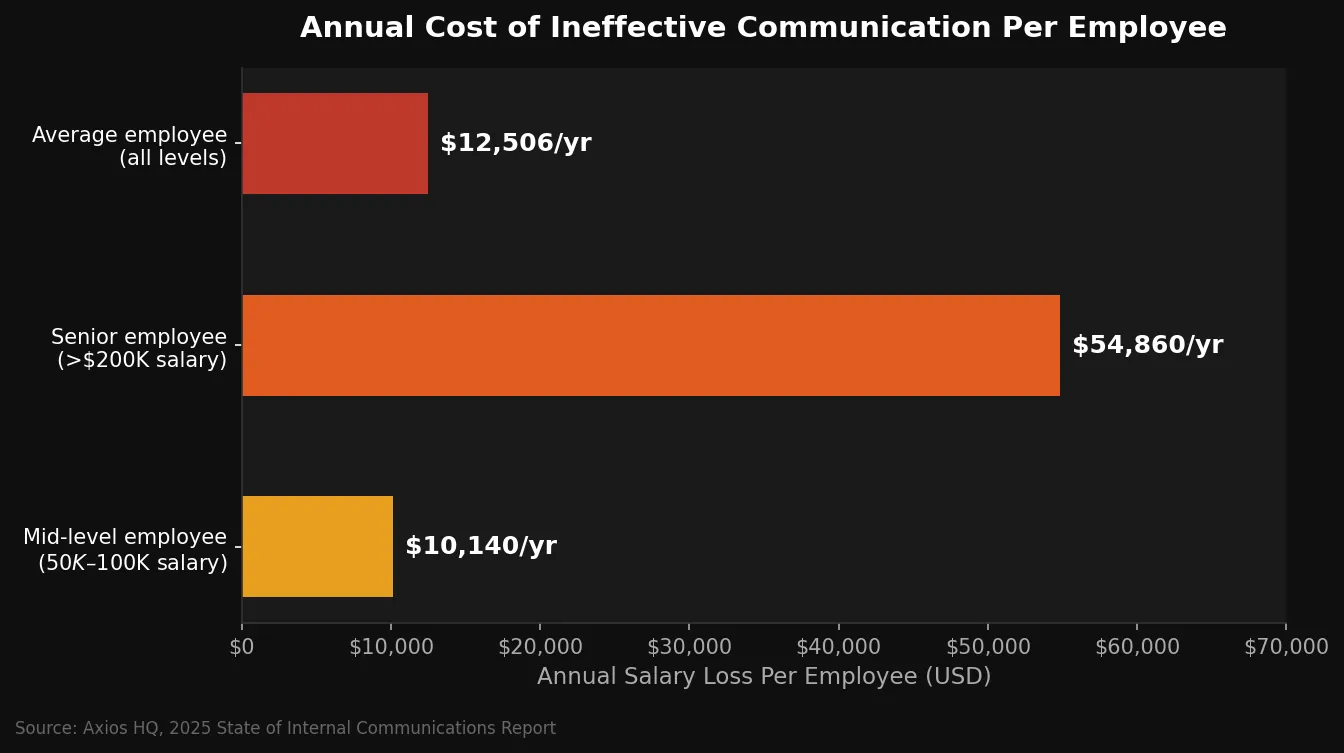
Annual salary wasted per employee due to ineffective communication. Sources: Axios HQ, 2025 State of Internal Communications Report; Grammarly and The Harris Poll.
Leadership Is Not Immune — It’s Drowning In It
- 33% of leaders were forced to drop their own priorities to put out fires caused by poor communication.
- 30% of leaders were dragged deeper into projects than they should have been because of communication breakdowns.
- 27% of leaders reported spending excessive time clarifying objectives that should have been clear from the start.
- Among C-suite leaders specifically, 48% have had to take on more project involvement than they should due to poor communication, 41% report higher employee turnover as a direct consequence, and 34% say their organization lost a customer or underperformed on a project because of it.
The Alignment Gap Is Widening
- 80% of leaders believe their internal communications are clear and engaging. Only 50% of employees agree.
- 27% of leaders believe their staff are fully aligned with organizational goals. Only 9% of employees agree.
- Only 12–16% of employees describe the critical updates they receive from leadership as “very effective.”
These aren’t rounding errors. They’re systemic failures playing out every day across every shift, every job site, and every service call.
The Field Worker Communication Gap Is a Category of Its Own
The Axios HQ data covers the corporate workforce. But the problem is far more acute for businesses whose employees are in the field — away from desks, email, office whiteboards, and direct supervision.
Consider this: deskless and frontline workers make up approximately 80% of the global workforce — roughly 2.7 billion people, according to WorkforceLogic. Yet most communication tools and systems are built for the 20% sitting at desks.
A Staffbase study found that only 10% of deskless workers are very satisfied with the quality of workplace communication they receive. Nearly one-third — 32% — say their organizations communicate less effectively with them compared to their desk-based counterparts, according to Staffbase’s 2025 International Employee Communication Impact Study.
78% of deskless workers don’t have a company email address. 72% don’t use a company intranet, according to ScreenCloud. They are, in the most literal sense, cut off from the information flow that keeps operations running efficiently.
For field service businesses, that disconnect translates directly into:
- Missed or delayed job assignments
- Technicians arriving without accurate job information
- Clients left waiting without status updates
- Dispatchers paralyzed by inbound “where is my tech?” calls
- Rework, callbacks, and service failures
Industry-by-Industry: The Communication Tax You’re Paying
Construction & Specialty Trades
Construction is the single most quantifiable example of what communication failures cost.
A landmark joint study by PlanGrid and FMI Corporation found that the U.S. construction industry loses more than $177 billion annually due to poor communication, rework, and bad data management. Within that figure, miscommunication and poor project data are responsible for 48% of all rework on U.S. construction projects — translating to $31.3 billion in rework costs annually that can be traced directly back to communication failure.
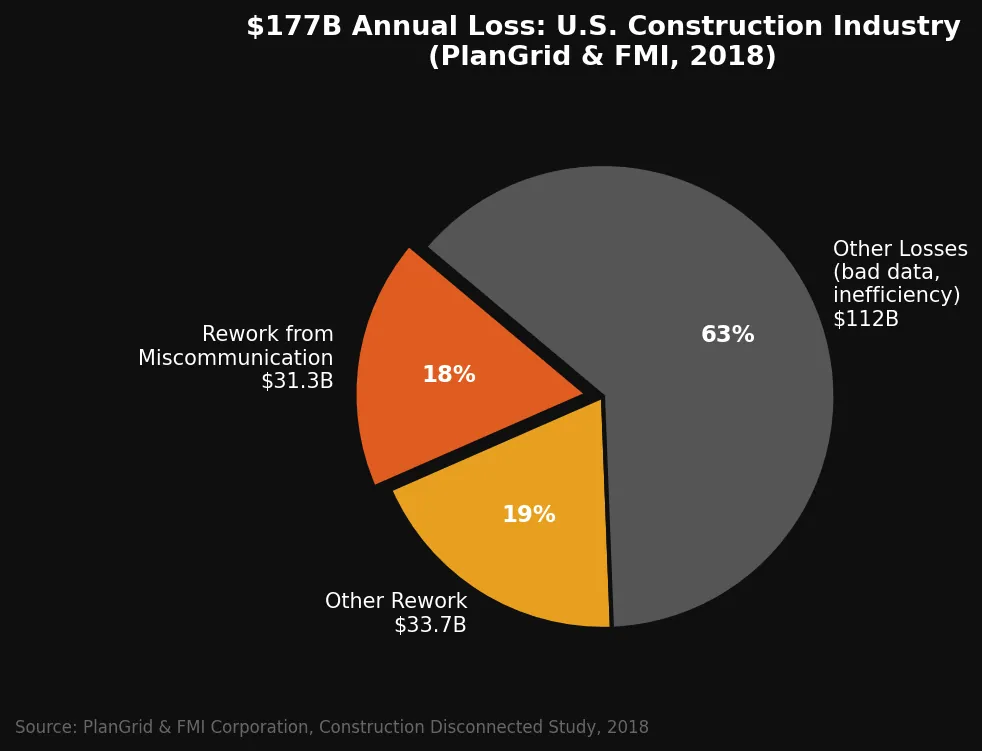
Breakdown of the $177B annual loss in the U.S. construction industry. Source: PlanGrid & FMI Corporation, Construction Disconnected, 2018.
The downstream effects are brutal:
- 56% of construction projects face scheduling delays linked to communication gaps, according to SmartBarrel.
- Rework consumes between 5–12% of total project costs across project types, according to PlanRadar.
- 90 minutes per worker, per day is lost on construction sites while crews wait for or chase down accurate information, according to Speakap.
For specialty subcontractors managing dozens or hundreds of field workers across multiple sites, every missed update or miscommunicated instruction is a direct hit to the bottom line. On thin margins, losing a few points to rework driven by poor communication is the difference between a profitable job and one you wish you’d passed on.
Home Service Businesses
Home services — HVAC, plumbing, electrical, cleaning, landscaping — operate in a world where the client is always watching.
Homeowners lose a remarkable amount of time every year waiting inside service appointment windows. The 4-hour appointment window isn’t just inconvenient for clients; it signals a company that doesn’t have its act together.
When field technicians operate without real-time job information, precise ETAs, and live dispatcher communication, the consequences compound:
- Technicians call dispatch repeatedly, slowing both sides down
- Clients call repeatedly, clogging the office with inbound inquiries
- First impressions are damaged before a technician knocks on the door
Research from Housecall Pro confirms what every home service owner already knows: when communication breaks down during arrival, pricing, or status updates, any trust that’s been built is immediately at risk.
Healthcare & Home Care Workers
In healthcare, communication failures are not just costly — they are dangerous.
The Joint Commission Center for Transforming Healthcare determined that an estimated 80% of serious medical errors involve miscommunication between caregivers, particularly during patient handoffs and transfers (Joint Commission Sentinel Event Alert 58). A 2025 meta-analysis of 46 studies found that poor communication was the sole identified cause of patient safety incidents in 10% of cases, and a contributing factor in up to 24% of all adverse events.
For home care workers — nurse aides, personal support workers, and home health aides — the communication challenges are amplified by geography. Workers operate alone, often in patients’ homes, with limited ability to reach supervisors or confirm care plan changes in real time.
The result is fragmented care: missed medication updates, unreported condition changes, and coordination failures between care teams that erode patient safety and increase organizational liability.
Poor communication in healthcare settings carries an estimated cost of $1.7 billion in malpractice costs over five years, according to data from CRICO Strategies cited by the HIPAA Journal — not counting the immeasurable human cost of preventable harm.
Limousine & Premium Transportation Services
In premium transportation, the brand is the experience — and the experience lives or dies on communication.
A chauffeur who can’t confirm a pickup in real time. A dispatcher who loses visibility of a driver mid-route. A client left standing outside a hotel because a confirmation never reached the driver. These are not edge cases. They are daily occurrences for limousine companies still running on phone calls, text threads, and manual dispatch.
Delayed driver-passenger-dispatcher coordination is recognized as a leading source of client frustration, brand damage, and lost repeat business in the premium ground transportation sector. In a business defined by punctuality and discretion, a single communication failure in front of a high-value client can cost a referral relationship worth thousands.
Any Company That Deploys People in the Field
The pattern is universal. Whether your field workers are delivering parcels, maintaining properties, performing inspections, installing equipment, or providing specialized services, the operational math is the same:
Communication gap → delayed action → missed opportunity → cost.
The Forbes Advisor State of Workplace Communication report found that nearly half of all workers report their productivity is directly affected by ineffective communication, and 42% experience work-related stress as a direct result.
When that stress and productivity loss belongs to a field worker who is your revenue-generating front line, it doesn’t stay in the office. It shows up in missed service windows, frustrated clients, unnecessary overtime, and declining morale.
What Businesses That Invest in Communication Actually Gain
The same research that documents the cost of poor communication also reveals the upside when organizations fix it.
The Axios HQ report found that organizations which increased their investment in communications outperformed those that didn’t across every measurable dimension:
| Metric | Increased Comms Investment | Flat / Reduced Investment |
|---|---|---|
| New business revenue | 63% saw growth | 37% |
| Customer retention | 67% improved | 33% |
| Market share growth | 67% saw gains | 33% |
| Employee retention | 68% improved | 32% |
| Culture and morale | 72% improved | 28% |
| Policy adherence | 72% improved | 28% |
| eNPS / Satisfaction scores | 73% improved | 27% |
Source: Axios HQ, 2025 State of Internal Communications Report
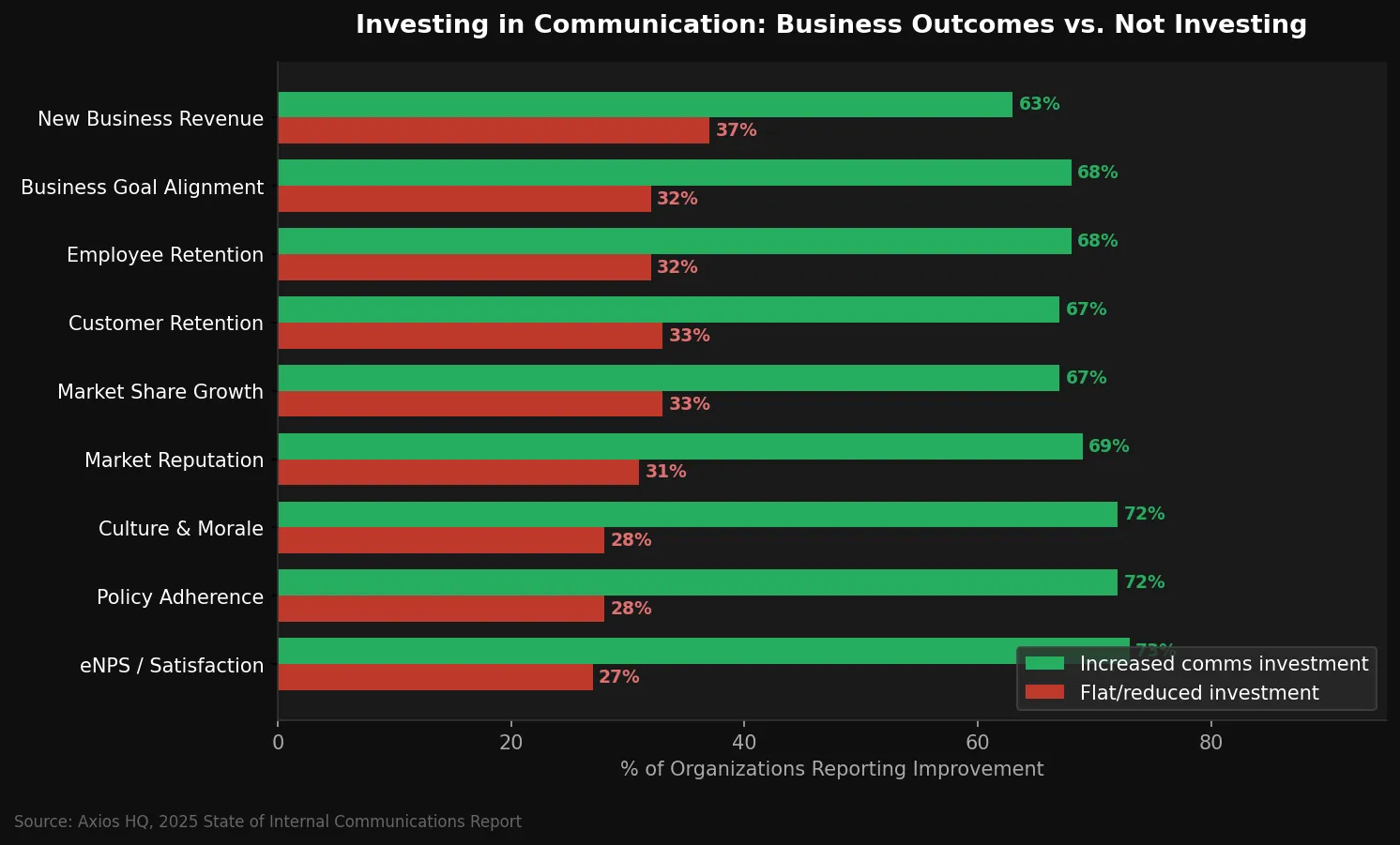
Organizations that increased communication investment outperformed across every business metric. Source: Axios HQ, 2025.
At the employee level, according to the same report, when workers understand company goals clearly and feel well-informed:
- Productivity increases by 63%
- Motivation improves by 59%
- Collaboration improves by 45%
- On-time project delivery improves by 35%
These are not incremental gains. They are major shifts in operational performance — available to any business willing to close the communication gap.
The ArrivePing Solution: Real-Time Communication for the Real World
ArrivePing was built to solve exactly this problem — not in a corporate boardroom, but in the field.
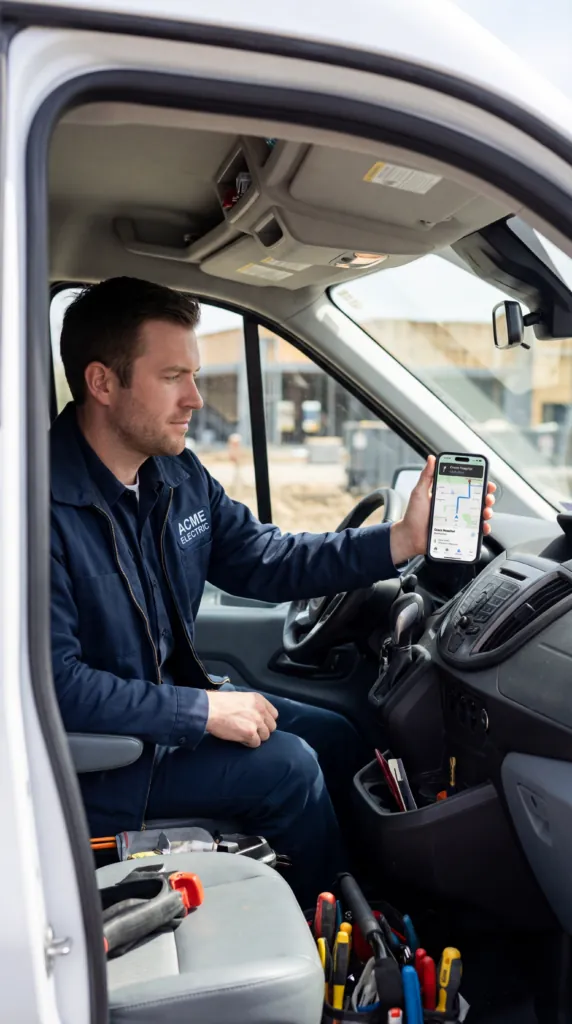
It was built by the team at NVC360 from the experience of operating a specialty subcontracting firm managing more than 800 field technicians. Every feature was designed to remove the communication friction that costs field service businesses time, money, and clients.
What ArrivePing Does
1. Live Map & Dispatch Visibility
Every active technician appears on a live map, using location from the technician app on their phone — no vehicle GPS hardware. Dispatchers see the full picture at a glance without calling around for status updates, and can reassign jobs from the dispatch board.
2. Automated Client ETA Notifications
When a technician heads out, ArrivePing sends the client an on-my-way text or email with a link to a live tracking page showing the technician’s progress and ETA, plus buttons to text or call. Clients can follow their technician much like an Uber, with no app or account to set up. If a job slips, a running-late notice goes out. Instead of waiting out a 4-hour window, clients know when to expect the knock at the door, which means fewer “where is my tech?” calls into the office.
3. Job Details That Travel With the Work Order
Each work order carries the job type, priority, time window, required skills, access notes and photos. Instructions travel with the work order — not through someone’s personal text thread.
4. Technician App & Job Closure
Technicians see job details on their phone (iOS and Android), accept with one tap, and mark themselves on the way. Arrival is geofenced and on-site time is clocked automatically. Job photos are attached to the record, and invoicing runs from the same job.
5. Works Alongside Your Existing Tools
ArrivePing works alongside your existing accounting and CRM tools, with exports (CSV, Excel, PDF, JSON), calendar feeds, webhooks, Zapier and Make. An AI setup agent builds your workspace from your company website, and most teams dispatch their first job within an hour. There is no hardware to install.
Where the Savings Come From
When technicians spend less time waiting for instructions, less time calling dispatch, and less time re-visiting jobs due to miscommunication, they can complete more service calls in the same number of hours. That is how better communication shows up in revenue per technician, overtime and margins.
This Is Not a “Nice to Have.” It Is a Competitive Necessity.
Every day your field operations run on phone calls, text chains, and manual dispatch, you are funding a communication tax — measured in lost hours, wasted salaries, frustrated clients, and preventable rework.
The businesses most exposed to this drain include:
- Home service businesses losing client trust through poor arrival communication
- Construction companies and specialty trades bleeding margin on rework caused by miscommunicated instructions
- Limousine and premium transportation services risking brand relationships on coordination failures
- Home care and healthcare workers navigating high-stakes environments without reliable real-time information
- Any company that deploys people in the field — where every minute of miscommunication is a minute of lost productivity
The research is unambiguous. The companies that invest in closing the communication gap don’t just perform better — they retain more customers, retain more employees, grow market share faster, and build cultures that compound over time.
Close the Gap
ArrivePing by NVC360 launches in November 2026, built in Winnipeg for businesses that deploy people in the field.
See how ArrivePing works for your team: book a demo.
References & Citations
- Grammarly & The Harris Poll. The State of Business Communication. Grammarly, 2022/2024.
- Axios HQ. Internal Communications Statistics: Findings from the 2025 Annual Report. Axios HQ, 2025.
- WorkforceLogic. The Overlooked Majority of Our Workforce: The Deskless Worker.
- Staffbase. Wake-Up Call for Business Leaders: Just 10% of Deskless Workers Are Very Satisfied with Workplace Communication.
- Staffbase. 2025 International Employee Communication Impact Study.
- ScreenCloud. Deskless Worker Engagement: Communication Statistics.
- PlanGrid & FMI Corporation. Construction Disconnected: How Poor Data and Miscommunication Cost the Industry $177 Billion. FMI/PlanGrid Joint Study, 2018 (via PR Newswire).
- SmartBarrel. Why Poor Field Team Communication Costs You Big and How to Fix It.
- PlanRadar. Cost of Rework in Construction: Causes, Data & Prevention (2025).
- Speakap. The Hidden Cost of Outdated Communication in Construction.
- Housecall Pro. Home Service Customer Service Report: Trends & Statistics.
- The Joint Commission. Sentinel Event Alert, Issue 58: Inadequate Hand-off Communication. See also: HIPAA Journal. Effects of Poor Communication in Healthcare.
- The Conversation / BMJ. One in Ten Patient Safety Incidents in Hospitals Due to Poor Communication. 2025.
- CRICO Strategies. Malpractice Risks in Communication Failures. Cited in HIPAA Journal.
- Ground Alliance. Solving Today’s Chauffeur Business Challenges.
- Forbes Advisor. The State of Workplace Communication.