The $31 Billion Problem: How Poor Field Communication Drains Construction Profits
PlanGrid and FMI tie $31.3B a year in U.S. construction rework to miscommunication. Where field communication breaks down, what it costs, and how to fix it.
$31 Billion. Every Year. Gone.
Not lost to materials. Not lost to equipment failure. Not lost to labor shortages or rising interest rates.
Lost to miscommunication.
In 2018, PlanGrid and FMI Corporation published what remains the most rigorous study of waste in the U.S. construction industry. After surveying nearly 600 construction professionals across the country, they arrived at a finding that should have changed how every contractor, subcontractor, and project manager thinks about their operations: miscommunication and poor project data are directly responsible for $31.3 billion in rework costs annually — accounting for 48% of all rework on U.S. construction jobsites (PlanGrid & FMI, Construction Disconnected).
And rework is only part of the story. Total losses from non-optimal activities across the entire industry — conflict resolution, chasing project data, fixing preventable mistakes — reach $177 billion per year, according to the same study.
For most construction companies, this isn’t an abstract industry statistic. It’s the margin that disappeared on the last job. It’s the client who didn’t call back. It’s the crew standing idle while a foreman tracks down information that should have been on their phone before they arrived.
The problem is real. The cost is measurable. And the solution — for the companies that are getting ahead — is operational, not theoretical.
The Full Scale of the Problem: $177 Billion in Annual Destruction
To understand how communication failure becomes financial failure in construction, it helps to see the full breakdown of where the $177 billion goes.
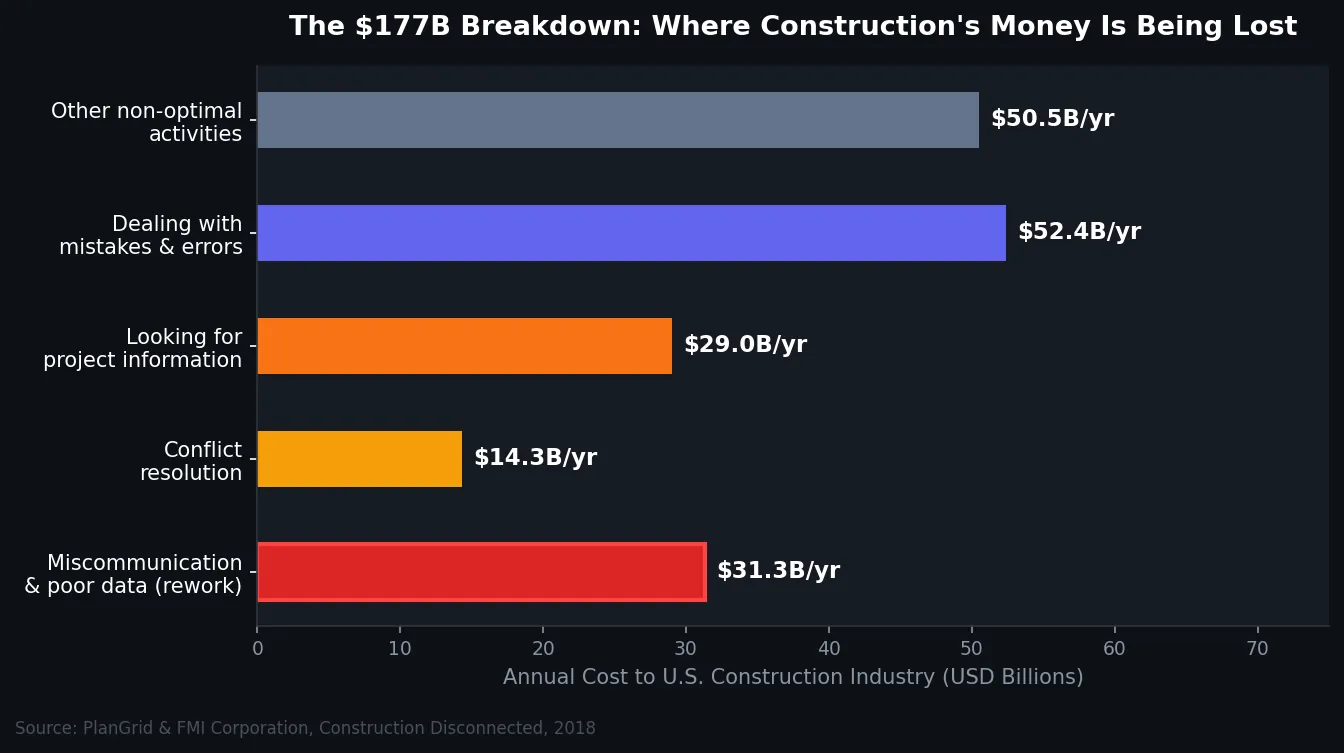
The $177B annual loss broken down by cause. Miscommunication-driven rework (highlighted) is the single largest identifiable contributor. Source: PlanGrid & FMI Corporation, Construction Disconnected, 2018.
Nearly every category on that chart traces back to the same root cause: information that should have been in the right hands at the right time — wasn’t.
The downstream consequences compound quickly:
- Nearly 30% of construction projects are delayed due to miscommunication — delays that increase costs, frustrate clients, and damage reputations (BuilderComs).
- According to McKinsey, 98% of megaprojects experience cost overruns, with an average cost increase of 80% over the original value (McKinsey, The Construction Productivity Imperative).
- Among all construction project sizes, nearly 80% fail to meet their original budget or timeline (industry analysis on LinkedIn).
- Construction productivity has grown at just 0.4% per year from 2000 to 2024 — one-seventh the rate of the broader economy — while manufacturing productivity over the same period has surged (Construction Dive).
This is not a technology problem or a labor problem at its core. It is a communication and coordination problem — one that no amount of skilled craftsmanship can overcome if the information infrastructure around the crew is broken.
The 35% Rule: How Much of Your Workforce Is Actually Working?
Here is a finding that should be posted on the wall of every construction company in North America.
The PlanGrid / FMI study found that construction professionals spend 35% of their working hours — more than 14 hours per week — on non-productive activities: hunting for project information, managing conflict, correcting mistakes, and navigating the communication gaps that define poorly run jobsites (PlanGrid & FMI).
Said another way: for every three workers you’re paying, one of them is effectively spending their entire shift doing work that communication failures created. They’re not building. They’re repairing, clarifying, waiting, and starting over.
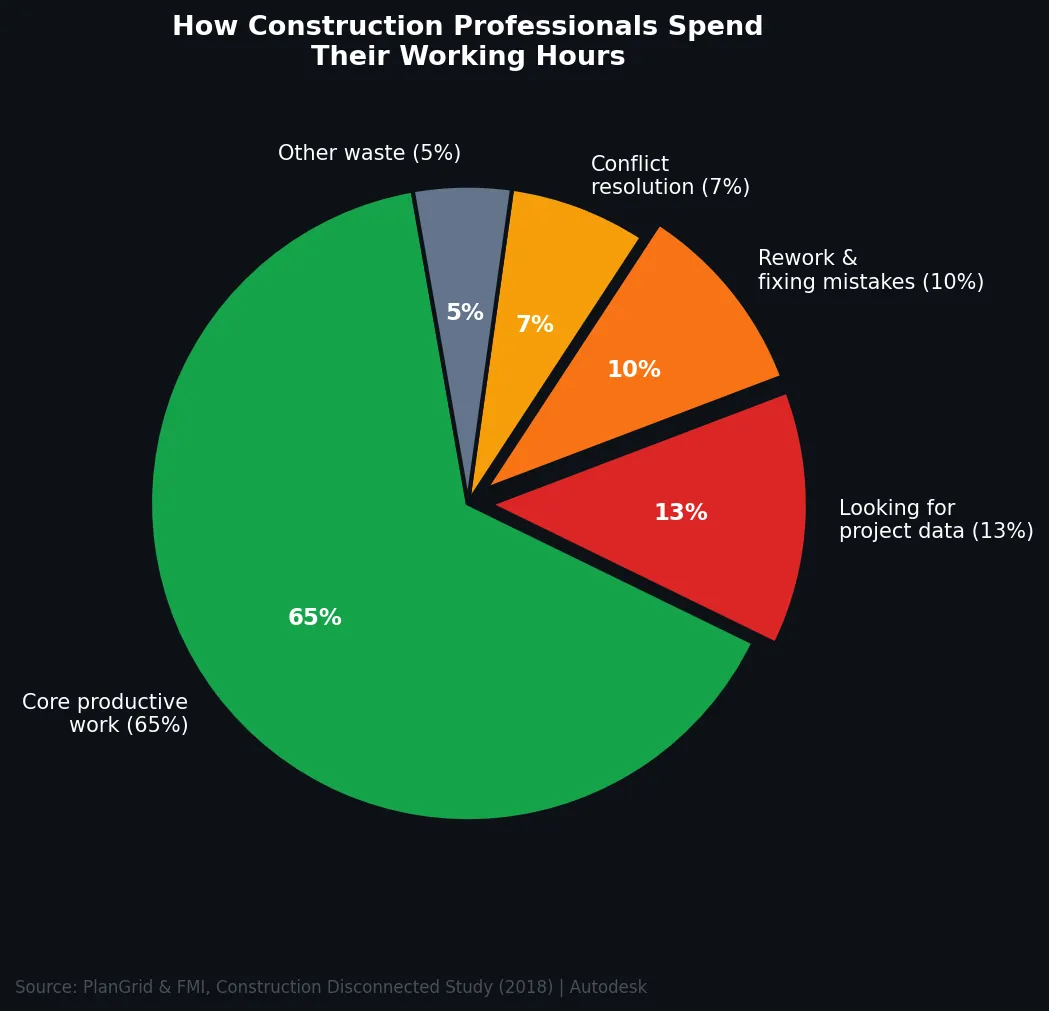
Only 65% of construction working hours go toward actual productive output. The remaining 35% is consumed by preventable communication failures. Source: PlanGrid & FMI, 2018.
Speakap’s analysis puts a concrete operational number on this: 90 minutes per worker, per day are lost on construction sites to crews waiting for or chasing down accurate information.
Multiply that across a 20-person crew, over a 6-month project, and you’re looking at thousands of lost labor hours — paid for at full wage, delivering zero output.
The Six Places Communication Breaks Down on Construction Sites
Based on the research, poor communication in construction clusters around six predictable failure points:
- Crew dispatch and job assignment — Workers arrive on site without current instructions, wrong materials, or misaligned scope. 26% of rework is attributed directly to poor communication (PlanGrid & FMI).
- Plan and drawing version control — Field crews working from outdated plans execute work that has to be torn out and redone. Autodesk data shows 14% of all rework globally is caused by bad data and outdated documents (Autodesk).
- Subcontractor coordination — When multiple trades are on site, coordination failures cascade. One trade starts work that blocks another, causing ripple delays across the entire project schedule.
- Field-to-office information lag — Project managers making decisions in the office are working from data that is hours or days old. By the time a problem surfaces in a report, it has already compounded in the field.
- Client-facing communication — Clients who don’t know the status of their project call. Repeatedly. Each call pulls someone off productive work to provide a manual update that a real-time system could have sent automatically.
- Job closure and documentation — Without digital job records, disputes arise over what was completed, when, and by whom. Change orders get lost. Payment is delayed. Relationships deteriorate.
Every one of these failure points is a communication gap. And every communication gap has a dollar amount attached to it — in rework, in delay, in overtime, and in client relationships that don’t survive the project.
What It’s Actually Costing Your Business (Run the Numbers)
The industry statistics are one thing. The business-level math is what makes this real.
Consider a mid-sized specialty subcontractor running $10 million in annual revenue with a 10% net margin — $1 million in profit per year. Industry research from PlanRadar and Construction Industry Institute data shows that rework typically consumes 5–12% of total project costs. If we take the conservative end — 5% — that’s $500,000 per year in rework costs alone. Cut that in half through better communication and coordination, and you’ve just added $250,000 to the bottom line. That’s a 25% profit increase from a single operational change.
Now add the labor waste. At 35% non-productive time, a 15-person field crew earning an average of $65,000 each represents roughly $341,000 per year in wages paid for zero productive output. Even recovering half of that through tighter job coordination represents $170,000 in recovered margin.
The numbers are not small. They are the difference between a construction company that compounds profitability year over year and one that grinds through volume hoping margin will show up somewhere.
How Top-Performing Construction Companies Are Fixing It

The gap between high and low communication maturity in construction is a measurable, quantifiable profit difference — not a style preference.
The research on what separates top-performing construction firms from the rest consistently points to one differentiator above all others: communication infrastructure. Not just communication habits — but the operational systems that make real-time, accurate information available to every person who needs it, at the moment they need it.
McKinsey’s research on construction digitization found that firms adopting digital communication and coordination tools can improve productivity by up to 15% and reduce project costs by up to 6% (McKinsey). For a $10M contractor, that’s up to $600,000 in recovered project costs — before counting reduced rework or eliminated overtime.
Autodesk’s broader industry data reinforces the gap between high and low communication maturity:
- 60% of general contractors report that coordination and communication problems between project team members are among their top operational challenges
- Construction firms with strong data strategies are significantly more likely to complete projects on time and on budget
- Companies that increased investment in connected data tools saw revenue increases of 1.4% and profitability increases of 1% annually — compounding advantages that grow with scale (Visibuild / Deloitte)
What the Best Companies Are Actually Doing Differently
The operational changes that top-performing construction companies have made are not complex. They share a common logic: make real-time information the default, not the exception.
- Live crew visibility — Dispatchers and project managers know where every worker is at all times. No calls. No radio chases. No guessing who is available for reassignment.
- Complete job information on every device — Scope, notes, drawings, checklists, safety requirements, and site photos travel with the work order — directly to the crew’s mobile device before they arrive on site.
- Automated client communication — Clients receive status updates, ETA notifications, and job completion summaries automatically. They don’t call to ask; they already know.
- Digital job closure — Work is documented, signed off, and filed in real time. No paper trails, no disputes, no lost change orders.
- Field-to-office data in real time — Project managers see what’s happening on site now, not what happened yesterday. Decisions get made on current information, not lagging reports.
None of this requires replacing existing systems or retooling entire operations. The companies leading in construction communication have adopted platforms that layer on top of their existing workflows — delivering real-time information without disruption.
Where ArrivePing Fits Into the Construction Communication Solution
ArrivePing was not designed in a software lab. It was built by NVC360 from software its founding team first wrote for National Interiors, a specialty subcontracting operation with more than 800 field technicians — where the communication failures described above were not hypothetical. They were daily operational realities eating margin, destroying schedules, and frustrating clients.
Every feature in ArrivePing exists because a real operational problem demanded it. Here is how it maps onto the failure points identified in construction communication research.
1. Eliminating Crew Dispatch Ambiguity
ArrivePing’s live map shows every technician and crew member in the field, using location from the technician app on their phone — no vehicle GPS hardware. Dispatchers see the full picture at a glance. Automatic assignment ranks available people by distance, skill match, availability and current workload, and the dispatcher can override any pick. Workers receive the job on their phone with what they need: job type, priority, time window, required skills, access notes and photos — before they leave for the site.
Rework that starts with a crew arriving under-informed is far less likely when complete, current job information is on their phone before they get there.
2. Closing the Field-to-Office Information Gap
With ArrivePing, on-the-way status, geofenced arrival, on-site time and job photos flow from the field to the office as they happen. Project managers are no longer working from yesterday’s information. When a job slips, it shows up on the dispatch board right away — not after it has compounded into a delay.
This real-time visibility addresses the lagging data problem that construction management researchers consistently identify as a driver of cost overruns and schedule slippage.
3. Automating Client Communication
When a crew heads out, ArrivePing sends the client an on-my-way text or email with a link to a live tracking page showing the crew’s progress and ETA, plus buttons to text or call. If the job runs late, the client gets a running-late notice. No app or account is needed on the client’s side. The client knows when you’re coming — without calling your office.
For construction clients managing project timelines, site access, and other trades, this is not just a convenience — it is a professional standard that builds trust and reduces the inbound call volume that pulls your team off productive work.
4. Digital Work Orders That Cut Rework at the Source
Every ArrivePing work order is digital and current. Crews capture job photos on site, the geofenced time clock records when they arrived and how long they worked, and invoicing follows from the job record.
When the job record is digital, complete, and timestamped, disputes over what was done, when, and by whom become much easier to settle.
5. Built for Crews of Any Size
ArrivePing’s custom work orders, job templates and online intake forms can be set up to match the way your crews actually work — residential, commercial, specialty trades or subcontracting. See how it fits construction trades specifically.
There is no new hardware and no capital expenditure. An AI setup agent builds your workspace — brand, services, priced catalog, job templates, intake forms and customer texts — from your company’s website, and most teams dispatch their first job within an hour. ArrivePing works alongside the accounting and CRM tools you already use.
The Bottom Line
The PlanGrid / FMI finding that 48% of rework traces back to miscommunication and poor project data is exactly the gap ArrivePing was built to close. And if it doesn’t make your dispatch day calmer within the first month, you get a refund.
The Construction Companies That Move First Will Own the Margin Advantage
The $31 billion communication problem in construction is not a secret. The research is public, the data is clear, and the solution playbook is well-established. What separates the companies that are fixing it from those that aren’t is simply this: the willingness to act on the information.
In a market where most contractors are still running dispatch on phone calls and managing crew updates through text threads, the company that deploys real-time communication infrastructure is not just more efficient. It is more competitive — better margins, fewer disputes, faster project cycles, and clients who sign repeat contracts because the experience of working with you is noticeably better.
That competitive gap is available to any construction business willing to close it:
- General contractors losing schedule control to coordination failures between trades
- Specialty subcontractors absorbing rework costs they can’t charge back because the communication failure was internal
- Residential builders managing client expectations across multi-month projects without a system for proactive updates
- Commercial construction firms watching margin evaporate on large projects where field-to-office lag turns small problems into expensive ones
- Any construction company managing crews in the field where the gap between what dispatch knows and what workers have costs money every single day
ArrivePing launches in November 2026. See how it works for your crews: book a demo.
References & Citations
- PlanGrid & FMI Corporation. Construction Disconnected: How Poor Data and Miscommunication Cost the Industry $177 Billion. FMI/PlanGrid Joint Study, 2018. Full report: Construction Disconnected PDF. PR Newswire: Press Release. Autodesk summary: Autodesk Blog.
- BuilderComs. The $31 Billion Problem: Why Communication Fails in Construction and How to Fix It.
- McKinsey Global Institute. The Construction Productivity Imperative. McKinsey & Company. McKinsey PDF. See also: BuildAgent, Why 80% of Construction Projects Go Over Budget.
- LinkedIn / Industry Analysis. Why 80% of Construction Projects Miss Budget & Deadlines.
- McKinsey & Company. Reinventing Construction: A Route to Higher Productivity. McKinsey Global Institute, 2017. Full Report PDF. See also: Construction Dive, Why Construction Productivity Growth Is Lagging.
- Speakap. The Hidden Cost of Outdated Communication in Construction. See also: BMD Materials. The Hidden Cost of Outdated Communication in Construction.
- Autodesk. 100+ Construction Industry Statistics. Autodesk Construction Cloud Research.
- PlanRadar. Cost of Rework in Construction: Causes, Data & Prevention (2025). See also: InspectMind AI. True Cost of Construction Rework.
- McKinsey & Company. Accelerating Growth in Construction Technology. McKinsey Insights. See also: The Joy Factory. How Digital Workflows Are Transforming Construction.
- Visibuild / Deloitte. State of Digital Adoption in the Construction Industry 2024. See also: Deloitte. State of Digital Adoption in Construction.